
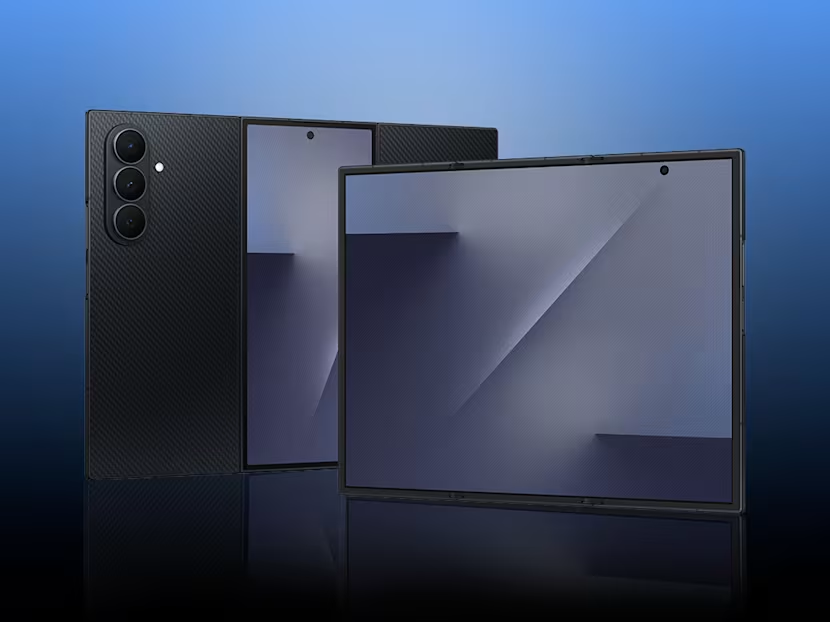
Samsung Galaxy Z TriFold launches Dec 12. Compare with Huawei Mate XTs: display, cameras, performance & folding tech in the ultimate trifold showdown.
In an effort to blur the distinction between a phone and a small tablet, Samsung has formally unveiled the Galaxy Z TriFold, its most ambitious foldable to date. It features three screens and many hinges. On December 12, the gadget will make its debut in South Korea before spreading to other international markets, ushering in a new era of foldable competitiveness.
But with the Mate XTs, which were introduced in China earlier this year, Huawei entered the trifold market first. Built on HarmonyOS and powered by the Kirin 9020, it is well-liked by consumers seeking huge screens, flexible multitasking, and sophisticated folding structures. The comparison is unavoidable since the engineering methodologies used by the two brands are so dissimilar.
Create and Construct
When closed, Samsung’s Galaxy Z TriFold’s elegant inward multi-fold design shields the primary display. Its Armour FlexHinge technology, which is supported by an Advanced Armour Aluminum frame and a titanium hinge housing, features two hinges of varying sizes that fold smoothly with little gap. Samsung emphasizes its internal quality controls, which include laser precision measurements and CT scans. Additionally, the gadget comes with IP48 protection, support for two SIM cards, and OneUI 8, which is based on Android 16.
For structural stability, Huawei’s Mate X has parallel geometric embossing in a unique trifold design. It weighs 298 grams and has a white and purple leather-textured surface. The phone incorporates a multi-antenna architecture and even satellite connectivity for low-signal areas, and its Tiangong dual-track hinge allows for seamless transitions. The gadget can be set up with one, two, or three screens.
Also read: Apple Updates Vintage Device List: iPhone SE, iPad Pro Obsolete
Experience with Display
With a 6.5-inch FHD Plus outer screen and a 10-inch inner Dynamic AMOLED 2X display, Samsung outfits the TriFold with full DCI-P3 coverage and adjustable refresh rates up to 120 Hz. Gorilla Glass Ceramic 2 is applied to the cover, while Ceramic Glass Fibre is used to reinforce the rear panel.
With 6.4-inch, 7.9-inch, and 10.2-inch OLED LTPO screens that change based on how the device is folded, Huawei’s Mate XTs provide a more seamless screen evolution. P3 gamut, 1440 Hz PWM dimming, 240 Hz touch input, and 1.07 billion colors are all supported. The phone is more suited for presenters and makers when it supports the M Pencil 3 stylus.
Systems for Cameras
A 200MP primary sensor with OIS, a 12MP ultrawide, and a 10MP telephoto with up to 30x digital zoom make up Samsung’s TriFold’s triple camera array. For the cover and internal screens, it has two 10MP selfie cameras.
With a 50MP primary camera with variable aperture and OIS, a 40MP ultrawide, a 12MP periscope lens with 5.5x optical and 50x digital zoom, and a 1.5MP multispectral sensor, Huawei’s Mate XTs chooses a quad arrangement. There is an 8MP ultrawide on the front.
Performance
With up to 16GB RAM and 1TB storage, Samsung’s Snapdragon 8 Elite for Galaxy is optimized for multitasking and foldable transitions.
The Kirin 9020 from Huawei is said to perform 20–36% better than its predecessor. Smooth mode switching, stylus input, and intensive multitasking are all made possible by HarmonyOS without causing any discernible lag.
Charging and Batteries
A 5600mAh battery powers both gadgets. Samsung offers both 15W wireless and 45W wired charging. 66W wired, 50W wireless, and 5W reverse charging are all supported by Huawei.
Also read: Apple Noida Store Launching on December 11 at DLF Mall of India
Concluding remarks
While Huawei’s Mate XTs concentrates on multi-mode use, stylus integration, and its more expansive triple-screen configuration, Samsung’s TriFold relies on durability, hinge architecture, and core software optimization. The future of foldables is defined differently by each device, but users’ preference for ecosystem stability over raw hardware flexibility may ultimately determine the outcome. It’s still unclear who will win this three-screen contest in the long run.