
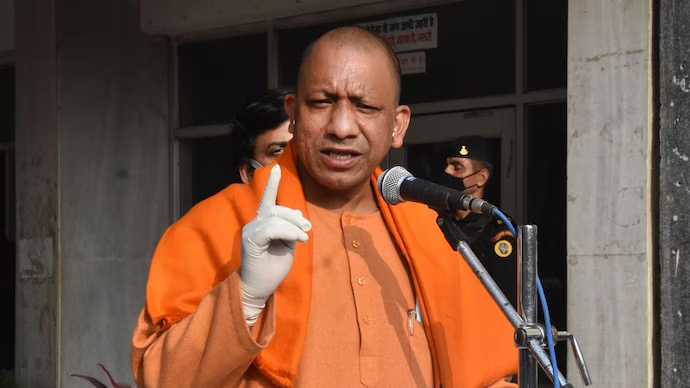
Uttar Pradesh CM Yogi Adityanath links halal certification to “political Islam,” sparking national debate ahead of key state elections and political shifts.
Yogi Adityanath, the chief minister of Uttar Pradesh, has once again sparked a national political debate as he has warned against the “expansionist design” of halal certification networks and described “political Islam” as a serious threat to India’s unity. Speaking at a cultural event in Gorakhpur, his remarks highlight the BJP’s broader ideological effort as the party gets ready for a series of crucial elections in Bihar, Uttar Pradesh, and other states.
The growth and impact of “political Islam,” as he put it, is a system that aims to alter demographics and establish religious hegemony, whereas British and French colonialism is frequently discussed in history, according to Adityanath. He claims that although India’s forefathers put up a centuries-long fight against this issue, the current generation is being urged to ignore it under the guise of minority rights and secularism.
A society ruled by Islamic principles, frequently including sharia law, is advocated by political Islam, which is the understanding of Islam as a source of political identity and activity. Despite its ambiguous connotation, term is used to characterize a variety of movements that aim to apply Islamic principles to political life.
Also read: Uttar Pradesh to Launch MSME Industrial Zones in Every District Starting October 31
At the same time that the state government has been examining halal-certified food more closely, Yogi made these comments. Businesses that provide halal certificates without statutory clearance are the subject of an investigation launched earlier this week by Adityanath’s administration, which claims that these certifications can be used to partition markets along religious lines and establish “parallel systems of regulation.”
In recent months, there has been a greater discussion over halal certification, which confirms that food and products are allowed under Islamic law. Authorities in Uttar Pradesh have questioned if these certificates are legitimately offered by private organizations and whether they adhere to the national criteria established by the Food Safety and criteria Authority of India (FSSAI).
The warning from Adityanath points to a more profound political and ideological dimension of the problem. In order to present halal certification as a component of a systematic effort to exert religious control over economic structures, he connected it to the more general concept of “political Islam.” According to him, these kinds of actions not only jeopardize India’s secular framework but also discriminate against non-Muslim companies that might feel pressured to obtain certification in order to compete in domestic or international markets.
Halal certification, according to critics, is largely a business need motivated by consumer demand, particularly in export markets like the Middle East and Southeast Asia. According to them, the government’s increasing antipathy towards these activities runs the risk of offending certain segments of the Indian populace and could lead to charges of religious polarization.
Time and political messaging
A political perspective is also necessary when analyzing Adityanath’s statement. While the BJP is preparing for the 2027 Uttar Pradesh Assembly elections, it is also facing elections in the neighboring state of Bihar, where Yogi is a well-known campaigner. His statements have reinforced the party’s emphasis on national security, religious pride, and cultural nationalism. Adityanath’s emphasis on “political Islam” seems to support the BJP’s ideological stance, which appeals to Hindu supporters by bringing up conflicts from the past and imagined dangers from the present.
In recent years, right-wing politicians around the world have coined the phrase “political Islam” to refer to the exploitation of Islamic identity for political mobilization. Adityanath fits his speech with a global conservative discourse by using the phrase domestically, but he also places it inside India’s distinct social and historical framework.
This is part of a larger plan, according to analysts, to keep religious and cultural problems fresh in the public consciousness, particularly in states like Uttar Pradesh where identity politics are crucial to elections. Thus, his criticism of halal certification accomplishes two goals: it targets what he refers to as religious exclusivism and conveys the BJP’s political commitment to “one nation, one law” government.
Adityanath’s remarks generated conflicting responses. His speech was praised by supporters as a brave admission of a problem that has never received much attention in public life. The chief minister, according to BJP leaders, only restated the party’s goal of preventing any religious organization from establishing its own distinct system inside the Indian state.
But he was accused by opposition leaders of widening socioeconomic gaps and exploiting religion as a diversion from urgent governance problems including unemployment, inflation, and rural suffering. The chief minister’s comments were meant to divide voters ahead of the next elections, according to the Samajwadi Party and Congress.
In response to Adityanath’s comments, Ziaur Rahman Barq, a member of the Samajwadi Party, called them “baseless” and called for proof to back up his assertions. In addition to calling the state’s decision to limit halal certification “unconstitutional,” Barq claimed the chief minister was “making statements without proof.”
“Halal certification concerns both trade practices and religious freedom. Without concrete proof of misconduct, the government shouldn’t become involved in these matters,” Barq stated. In order to sow religious division before elections, he continued, Yogi Adityanath’s remarks regarding “political Islam” and halal networks seem to be politically driven.
Also read: Yogi Adityanath Stands with Punjab Farmers, Sends Wheat Seeds
Politically speaking, the dispute highlights the conflict between India’s secular government and religious customs. Additionally, it calls into question the extent to which public institutions need to get involved in private business or religious affairs.
Yogi Adityanath has rekindled a complicated discussion that cut beyond religion, politics, and the economics by associating halal certification with “political Islam.” His caution reveals the BJP’s larger ideological goal, which is to redraw the lines separating India’s religious and political spheres. Depending on how the government strikes a balance between its cultural rhetoric and administrative practicality in the next months, this narrative will either improve the party’s political standing or cause new social unrest.