
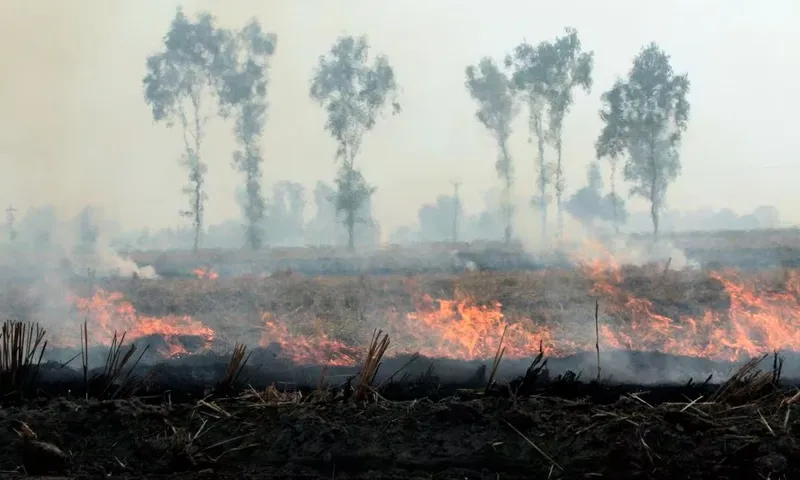
Stubble burning in Punjab-Haryana drops over 90% in 2025, improving Delhi-NCR air quality, thanks to government policies and green initiatives.
Chandigarh: Punjab and Haryana have documented a substantial decline in stubble burning incidents this year, resulting in clearer skies and improved air quality in the Delhi-NCR region, according to official data.
Data from the Commission for Air Quality Management (CAQM) indicates that Punjab reported 5,114 farm fire incidents in 2025, representing a 93 percent decrease from 2021.
Haryana reported 662 cases, representing a 91 percent decrease.
Satellite data from the Consortium for Research on Agroecosystem Monitoring and Modeling from Space (CREAMS) laboratory also revealed a significant decline in paddy straw burning, indicating a 57 percent decrease—from 42,962 cases in 2023 to 18,457 in 2024.
Multiple districts demonstrated significant progress.
Sangrur experienced a 60 percent decrease, with 693 cases in 2025, while Ferozepur recorded a 59 percent reduction, and Muktsar a 55 percent decline in vegetation burning incidents, according to the data.
Tarn Taran, with 685 agricultural fires, and Bathinda, with 368, also recorded a notable decrease in incidents compared to previous years.
Also read; Punjab Launches Arts-Integrated Curriculum with SEL Focus
In Haryana, the majority of cases originated from Jind (47), Fatehabad (28), and Kaithal (27).
With a reduction in agricultural fires, the air quality in Delhi-NCR has markedly improved.
Official data indicates that the number of days with an Air Quality Index (AQI) below 200 rose from 110 days in 2016 to 200 days in 2025.
According to experts, the development is attributable to government policies, increased awareness among farmers, the adoption of new agricultural techniques, and initiatives undertaken by the private sector, officials stated.
Waste-to-energy companies are assisting farmers in utilizing crop residue to generate renewable energy, rather than incinerating it in the fields, they added.
Laxit Awla, Executive Director and CEO of SAEL Industries, stated that the company is actively engaged in converting crop residue into green energy through its facilities in Haryana, Punjab, and Rajasthan, thereby promoting pure power generation and maintaining regulated emissions.