
PEDA reports major clean-energy progress in 2025 with solar pumps, CBG plants, rooftop systems, and agri-waste energy projects across Punjab.
By utilizing solar energy and agricultural waste, the Punjab Energy Development Agency (PEDA) is leading Punjab to become a leader in renewable energy. Agri-waste generates clean energy, while the sun powers houses and farms. Aman Arora, Punjab’s Minister for New and Renewable Energy Sources, reflected on the revolutionary advancements in the renewable industry in 2025 and said that PEDA turned policy into power, creating a quantum leap in Punjab’s sustainable future.
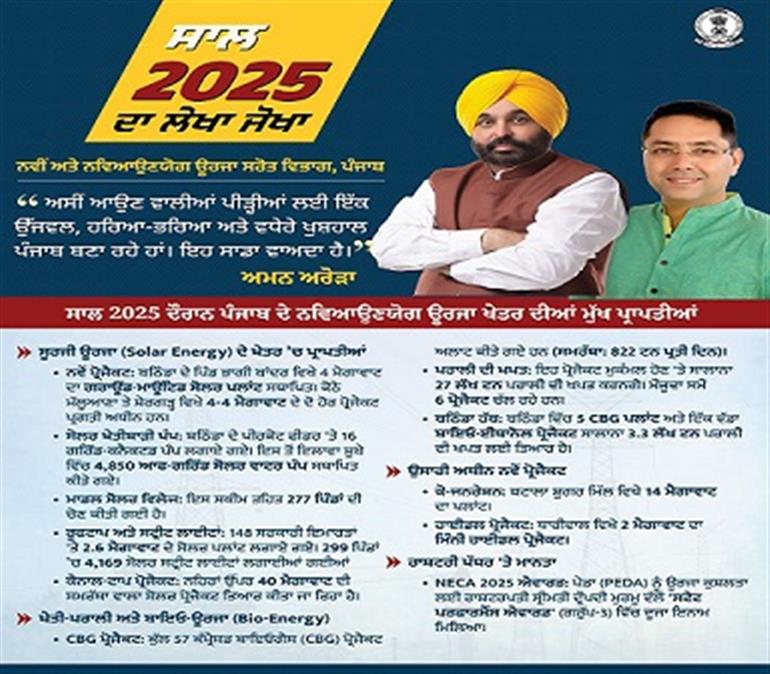
According to Aman Arora, Punjab’s relationship with the sun has grown this year as two 4 MW solar power projects are being implemented at Kothe Malluana and Shergarh in Bathinda, and a 4 MW ground-mounted solar power project was put into service in July 2025 at the village of Bhagi Bandar in Bathinda. On the Peerkot feeder in Bathinda district, PEDA has also constructed 16 grid-connected agricultural pumps to eliminate carbon footprints in the agriculture sector. Four more pumps are now being erected.
Also read : Punjab Govt Expands BACKFINCO Loan Support to Uplift Minority and EWS Communities in 2025–26
Additionally, PEDA has placed 4,850 independent, off-grid solar water pumps in different parts of the state. Up to 277 villages have been selected to become independent energy hubs under the Model Solar Village Scheme. Over 4,169 solar street lights are lighting up 299 communities this year, and 2.6 MW of rooftop solar power plants have been placed on 148 government buildings, promoting safety and communal life after dark. He also mentioned that 1,221 solar street lights are now being installed in 65 villages.
57 Compressed Biogas (CBG) Projects with a total capacity of 822 Ton CBG Per Day have been allocated, the Cabinet Minister stated, sharing an affecting story being written in the fields. After they are put into service, these projects will use more than 27 lacs of paddy straw every year. There are six operational CBG projects with a combined capacity of 107.48 TPD. In Bathinda, a large bio-ethanol facility and five future compressed bio-gas facilities are expected to use more than 3.3 lakh tonnes of paddy straw a year. Agricultural residue drives progress and cleans the environment in a circular economy, which goes beyond waste management. Punjab is constructing an energy infrastructure that is resilient and varied. The innovative 40 MW Canal-Top Solar project will produce electricity while conserving water and land. He said a dedication to utilizing all renewable resources is demonstrated by a 2 MW Mini Hydel project in Dhariwal and a 14 MW Co-generation plant at Batala Sugar Mills.
PEDA has received national acclaim for its work in green energy and energy efficiency. According to Aman Arora, Hon’ble President Smt. Droupadi Murmu awarded PEDA the second prize in the State Performance Award (Group-3) under NECA 2025.
Also read : Punjab Govt’s Shakti Helpline: Praised as Revolutionary Child Safety Shield
The Punjab government under CM Bhagwant Singh Mann’s unwavering commitment has created a new route where environmental stewardship, farmer prosperity, and energy conservation meet. Aman Arora continued, saying, “There is a noticeable improvement. It may be seen in the village square illuminated by solar lights, in the farmers whose irrigation expenses have drastically decreased, and in the cleaner air we breathe. We are driving a more wealthy, greener, and brighter Punjab for future generations. We assure you this.
According to Dr. Basant Garg, Administrative Secretary for New and Renewable Energy Sources, Punjab is doing more than merely embracing renewable energy. It is incorporating it into its development process. A cleaner environment, economic resiliency, and energy independence are all aimed for by each project.