
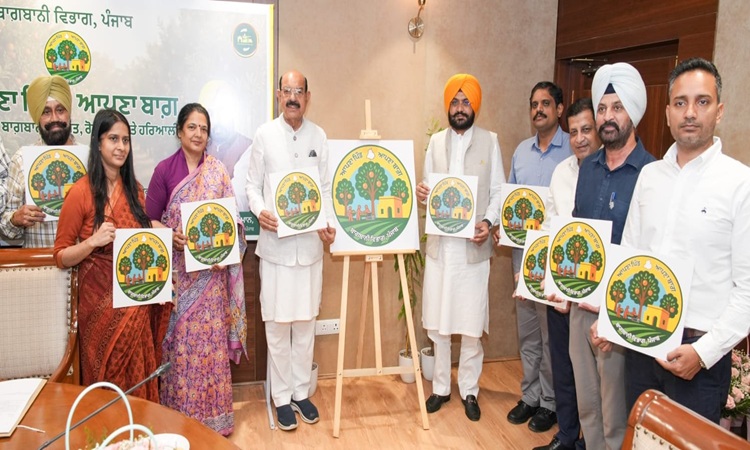
Punjab launches ‘Apna Pind – Apna Bagh’ horticulture drive
Chandigarh : The Punjab Government has rolled out a new initiative to promote horticulture and crop diversification by planting fruit orchards on panchayati land. The campaign, titled ‘Apna Pind – Apna Bagh’, was jointly launched by Horticulture Minister Mohinder Bhagat and Rural Development and Panchayats Minister Tarunpreet Singh Sond in Chandigarh on Wednesday.
The programme, backed by Chief Minister Bhagwant Singh Mann’s vision of creating a “Hara Bhara Punjab,” aims to transform unused village lands into green spaces while boosting rural income and employment.
Orchards to cover 65 acres in phase one
Under the first phase of the campaign, fruit orchards will be established on 65 acres of panchayati land in nine districts. The distribution includes:
- Hoshiarpur: 22 acres
- Pathankot: 15 acres
- Ludhiana: 5 acres
- Gurdaspur: 5 acres
- Malerkotla: 4 acres
- Kapurthala: 4 acres
- Bathinda: 6 acres
- Amritsar: 2 acres
- Jalandhar: 2.5 acres
The orchards will be maintained under MGNREGA for the first three years, ensuring jobs for rural workers. Afterward, the projects will be handed over to local panchayats, allowing villages to generate steady income from fruit sales.
Boosting rural economy and self-help groups
Horticulture Minister Mohinder Bhagat highlighted that the initiative is not only an environmental step but also an economic one. Income generated from orchards will directly support village development activities, while fruit processing will provide new opportunities for self-help groups (SHGs), enhancing women’s participation in the rural economy.
He added that interested panchayats may pass a resolution and request orchards to be set up on their lands, thereby expanding the programme beyond the initial phase.
Water conservation and climate benefits
Rural Development and Panchayats Minister Tarunpreet Singh Sond underlined that the campaign will play a key role in water conservation. He pointed out that canal water, which was previously underutilized, is now being efficiently managed by the Water Resources Department for irrigation.
“This initiative will not only strengthen horticulture but also reduce dependence on groundwater and contribute to combating global warming,” he said, urging more village panchayats to join the project.
Government’s long-term vision
The ‘Apna Pind – Apna Bagh’ campaign aligns with Punjab’s broader strategy of crop diversification, moving farmers away from the water-intensive wheat-paddy cycle towards more sustainable farming.
With support from the Horticulture Department and Rural Development and Panchayats Department, the project represents a joint government effort to tackle agricultural, economic, and environmental challenges simultaneously.
Senior officials including Ajit Balaji Joshi (Secretary, Rural Development and Panchayats), Babita (Agriculture Commissioner), and Shailender Kaur (Director, Horticulture) were also present at the launch, emphasizing the campaign’s importance for Punjab’s rural transformation.
Conclusion
By planting fruit orchards on village lands, Punjab aims to create greener villages, generate rural income, and ensure long-term sustainability in agriculture. As more panchayats join the initiative, the ‘Apna Pind – Apna Bagh’ campaign could emerge as a model of rural development that balances economy and ecology.