
New holy city rules in Punjab spark debate over non-veg bans, alcohol restrictions, and effects on local business.
Concerns have been made about the practical implementation of the Punjab government’s decision to confer holy city status to the walled city of Amritsar, Anandpur Sahib, and Talwandi Sabo, particularly with regard to the impact on local businesses.
The resolution, which was approved at a special Punjab Vidhan Sabha session at Anandpur Sahib, forbids the sale of tobacco, alcohol, non-vegetarian cuisine, and other intoxicants in certain areas.
Concerns about livelihood
The fourth Sikh teacher, Guru Ramdas, founded the walled city of Amritsar, which is the city’s historic center. Maharaja Ranjit Singh subsequently strengthened it by erecting sturdy walls and gates. The British strengthened the city’s defenses during the colonial era by enlarging and rebuilding a number of these gates.
Also read : CM Bhagwant Mann’s Yudh Nashian Virudh Campaign: 81 Arrests, Drugs Seized in Punjab
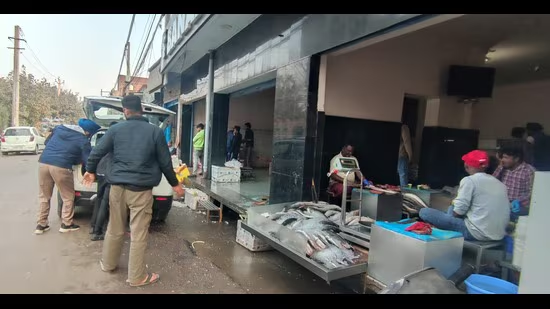
According to Balwinder Singh, a renowned cultural conservation specialist and retired professor at Guru Nanak Dev University (GNDU) Amritsar, a number of restaurants serving non-vegetarian fare have been operating in the walled city, which spans 3.52 square kilometers, for decades. Inside Hall Gate, there is a full-fledged fish market.
Due in large part to the surge of tourists visiting the Golden Temple, the walled city has experienced significant growth in recent decades. The neighborhood has seen the growth of numerous small hotels and restaurants that serve non-vegetarian food.
Owners of non-vegetarian restaurants located in the walled city are concerned about the declaration, even though the government has not yet issued a notification in this regard. The proprietor of the well-known Pal Dhaba close to Hathi Gate, Jasvir Singh, voiced his worries: “Our dhaba has been running for 70 years.” We don’t have any additional revenue streams or branches. We will lose our jobs if our store closes.
The owner of a seafood store in the Hall Gate neighborhood, Gurjit Singh, stated he would not oppose to relocating his company beyond the walled city. Many stakeholders, however, contend that moving such established companies won’t be simple.
Different responses
Some people are happy about the change, while others are worried about how it may affect nearby companies. Many non-vegetarian restaurants have already moved to places like the Civil Lines in recent years, according to Surinder Singh, head of the Hotels and Guest Houses Association. He recommended that in order to assist impacted businesses, the government think about creating a food court.
The decision was endorsed by APS Chatha, head of the Amritsar Hotels and Restaurants’ Association (AHARA) in Civil Lines, who compared it to the situation in Haridwar, where some prohibited commodities are allowed outside of the main holy zones. “This will satisfy the needs of those who are looking for non-vegetarian food while also helping to preserve the sanctity of the holy city,” he said.
demands stringent building regulations
Strict legal frameworks are required to enforce prohibitions on non-vegetarian food, alcohol, tobacco, and immoral activities in the holy city, according to local organizations like the Amritsar Vikas Manch, which is led by Kulwant Singh Ankhi and Surinderjit Singh. They also emphasized how crucial it is to maintain the area’s architectural integrity.
ALSO READ : Punjab Hosts Grand ‘Sarbat Da Bhala Ikattarta’ to Honour Guru Tegh Bahadur Ji’s 350th Martyrdom Anniversary
Ankhi stated, “Building regulations should be enforced, particularly the restriction on multi-storey buildings near the Golden Temple,” alluding to current bylaws that set a 38.5-foot maximum construction height. “This ought to be required, even for buildings constructed by the Kar Sewa Babas or the Shiromani Gurdwara Parbandhak Committee (SGPC),” he continued.
Concerns of unlawful hotels operating close to the Golden Temple were voiced by advocate Sarabjit Singh Verka, chief investigator at the Punjab Human Rights Organization (PHRO). These businesses continue to operate, frequently unregulated by local authorities, despite ongoing proceedings before the Supreme Court.
Since they are awaiting additional written instructions from the government on how to proceed with the legal framework for the holy city status, officials have chosen not to comment on these issues.