
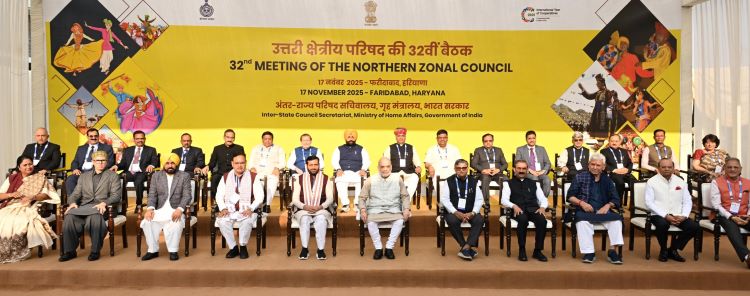
Punjab CM Bhagwant Mann presses claims on Chandigarh, Punjab University, and water rights, urging true federalism at the 32nd Northern Zonal Council.
At the 32nd meeting of the Northern Zonal Council, Punjab CM Bhagwant Mann adamantly reaffirmed his claims over Chandigarh, Punjab University, and river waters in addition to supporting a true federal structure for the nation in front of Union Home Minister Amit Shah.
The Indian Constitution, the Chief Minister pointed out, clearly defined the domains in which the Union and the States must operate in order to carry out their respective powers. Federalism is still one of the fundamental tenets of our Constitution, he continued, but over the past 75 years, there has been a regrettable trend toward the concentration of power. Being at the forefront, state governments are in a far better position to comprehend, address, and resolve the issues facing their citizens, Bhagwant Singh Mann emphasized.
The Chief Minister fervently pleaded for the transfer of Chandigarh to the state of Punjab, stating that the Rajiv-Longowal Accord, signed on July 24th, 1985, between then Prime Minister Rajiv Gandhi and Sant Harchand Singh Longowal, explicitly reaffirmed that Chandigarh will be transferred to Punjab, after the state’s reorganization, the Indira Gandhi Agreement of 1970 explicitly stated that “the capital project area of Chandigarh will, as a whole, go to Punjab, which was a clear commitment from the Central Government.” Bhagwant Singh Mann lamented that Chandigarh was not transferred to Punjab despite all promises, which has wounded the hearts of every Punjabi.
“It is a matter of grave concern that officers of the IAS and the PCS have been excluded from key positions in the Chandigarh administration.” The Chief Minister brought up the issue of maintaining the status quo of the 60:40 ratio in the intake of service personnel from Punjab and Haryana in the functioning of the UT of Chandigarh, saying that it is urgently needed. According to Bhagwant Singh Mann, posts in departments like Excise, Education, Finance, and Health are being opened to cadres like the state UT cadre (DANICS), which negatively impacts the state of Punjab’s role in the efficient operation of the UT administration.
Also read : Free Diabetes & Health Screening Camp Held at Krishna Super Specialty Hospital
Another related issue, according to the Chief Minister, is the appointment of Punjab Cadre officers to the position of General Manager FCI (Punjab). He stated that the government of India should not change the long-standing practice of assigning an IAS officer from Punjab Cadre to the Regional Office of the FCI, given the state of Punjab’s consistently highest contribution to the Central pool. Bhagwant Singh Mann stated that the MD CITCO position has historically been filled by an IAS officer of Punjab Cadre, but UT state service officers are being appointed to this role, which goes against the policy established in the administration of the UT of Chandigarh based on a 60:40 ratio for the intake of personnel from Punjab and Haryana.
Following the suspension of the Indus Water Treaty, the Chief Minister stated that there is a great chance to resolve water-related issues involving the states represented here. He said that there is a chance to connect the Chenab river to the rivers Ravi and Beas, over which we already have dams controlling the water flow downstream. Bhagwant Singh Mann stated that the downstream states, including Punjab, could profitably use the surplus water inflow for irrigation and power generation, adding that the additional water would also help the State of Punjab meet its water deficit, especially in the border areas.
Speaking about the Bhakra Beas Management Board (BBMB), the Chief Minister vehemently opposed the idea of adding a full-time member from Rajasthan because the board was established by the Punjab Reorganisation Act, 1966, which only applies to the successor states of Punjab and Haryana. He claimed that Rajasthan and Himachal Pradesh are already represented as ex-officio members and that adding more full-time positions would only increase costs, the majority of which are borne by Punjab, with no practical benefit. Bhagwant Singh Mann stated that Punjab had already submitted a panel for member appointments, and the Indian government should stick with the original plan of having one member each from Punjab and Haryana.
Additionally, the Chief Minister was adamantly against any plan to increase the Full Reservoir Levels (FRLs) of the Bhakra and Pong dams. Following the devastating 1988 floods, he claimed that the FRLs were lowered to protect property and lives in Punjab, the only state that was impacted by the floodwaters. According to Bhagwant Singh Mann, the severe floods of 2019, 2023, and 2025 have confirmed that the current FRLs must be maintained.
According to the Chief Minister, Punjab lost a significant amount of money last year—nearly Rs. 13,500 crore—while Rajasthan was unaffected and had already declared that it could not handle any more water during floods. He said that because of the increasing siltation and structural stress, raising the FRLs would force emergency releases, putting downstream habitations in Punjab at risk. Bhagwant Singh Mann stated that the proper solution is desiltation, not raising the FRLs, and that Punjab requests that BBMB be instructed to maintain the current levels because the state has been suffering significant losses from floods for a long time.
The Chief Minister reiterated that the state has no excess water to spare through SYL, stating that no scientific calculation of water availability has been made since 1976, 1981, when the Government of India unilaterally decided the ratio of water to be shared among the states. He said that Punjab has been disputing the water availability at 17.17 MAF since 1981, especially since all international water agreements state that water availability must be evaluated every 25 years. According to Bhagwant Singh Mann, the 1981 water availability was based on the flow series 1921-1960, meaning that more than 20 years had already passed.
According to the Chief Minister, the availability of Ravi-Beas waters has drastically decreased, 75% of Punjab’s blocks are over-exploited, and the matter is being adjudicated before the Ravi-Beas Tribunal. He stated that all SYL proceedings should be put on hold until the Tribunal issues its final decision, adding that Punjab has already communicated that future discussions may only be possible after a new, scientific reassessment of water availability and only after Punjab’s essential requirements are fully secured. After the Indus Water Treaty was suspended, Bhagwant Singh Mann said that the Indian government should investigate the possibility of diverting the water from all western rivers to India.
Bhagwant Singh Mann also opposed the proposal to transfer control of the Ropar, Harike, and Ferozepur Headworks to BBMB, stating that no state in India has headworks run by an outside agency, and that Haryana itself maintains HathniKund on the Yamuna. The Chief Minister stated that any decision regarding the distribution of Ravi Beas waters should be put on hold until this exercise is completed because Punjab cannot consent to any action that jeopardizes its agriculture, groundwater security, and long-term sustainability.
Regarding the distribution of Yamuna waters, the Chief Minister stated that if Haryana is the successor to the Ravi-Beas waters, then Punjab is also entitled to them. He added that although the state shares Ravi-Beas waters with Haryana, Punjab was left out of the 1994 Memorandum of Understanding on Yamuna waters without any explanation. According to Bhagwant Singh Mann, the 1954 Agreement between undivided Punjab and Uttar Pradesh entitled Punjab to two-thirds of Yamuna waters, and the 1972 Irrigation Commission acknowledged Punjab as a part of the Yamuna basin.
According to Bhagwant Singh Mann, Punjab has already asked the Union Government to include it as a beneficiary in the Yamuna and Sharda–Yamuna Link projects as well, but our request has not been taken into consideration thus far. The Chief Minister stated that the Center and the respective States must make serious efforts to stop any flood waters going to Bay of Bengal through Yamuna. He also demanded that Punjab’s claim be given due consideration as the Memorandum of Understanding is scheduled for review after 2025.
Bhagwant Singh Mann stated that the Harike barrage was built in 1950 to divert water into the Rajasthan Feeder serving the areas of Rajasthan. The Chief Minister raised the issue of providing financial assistance to carry out flood protection works on the Border Outpost (BOP) of the BSF and the Army, saying that the proposal has not yet been approved by the Government of India. He urged the Government of India to release the entire funds without any conditions because it was in the interest of national security.
Bhagwant Singh Mann brought up the issue of the damage caused by the river Ghaggar, stating that in a 17-kilometer stretch in district Sangrur from Makror Sahib to Karail, the width of the river is too small to carry the waters. The Chief Minister said that the lack of desilting causes floods in the upstream areas right up to district Kapurthala and Jalandhar. He urged the Union government to assist the State Government both financially and in granting the environmental clearances.
According to the Chief Minister, the state government has been bringing up this issue for a long time and has even purchased land in the surrounding areas, but the cross section has not been expanded because of Haryana’s objections. Bhagwant Singh Mann urged the Indian government to convince Haryana to grant this request.
The Chief Minister stated that Punjab has a strong bond with the people of Punjab and that only Punjab has been supporting and fostering the university for the past 50 years. At this point, he said, we don’t understand why Haryana wants to affiliate its colleges with Punjab University when they have already been affiliated with Kurukshetra University, an A+ NAAC accredited university for the past 50 years. Bhagwant Singh Mann stated that he doesn’t understand what has changed for Haryana to seek this affiliation after ignoring Punjab University for the previous 50 years.
The Chief Minister warned that Punjab University is not just an academic institution but also an integral part of Punjabi identity, and he called for the restoration of democratic processes, including the announcement of elections for the original 91-member Senate. He said that Punjab has always supported Punjab University financially and is committed to doing so in the future as well, in accordance with a mutually consultative process. The Center’s recent attempts to restructure the university’s governance have been seen as interference in Punjab’s rights and to its state identity and autonomy, he said.
It is regrettable that the quantity of weapons smuggled from within the country (particularly from states like Madhya Pradesh) is significantly greater than that smuggled from across the border, and this needs to be checked with a heavy hand in the greater interest of national security, the Chief Minister said, highlighting another significant issue regarding the smuggling of weapons from within the country, saying that they are posing a grave threat to law and order in the state.
Also read : International Gita Mahotsav 2025: Artists Unite to Showcase Traditions
CM Bhagwant Mann Showcases Punjab’s Welfare Milestones and Disaster Recovery Efforts
“The success of a federal setup lies in the equitable prosperity of its states, which are not just constituents but partners in progress.” Water, the elixir of life, has been and continues to be the driving force behind Punjab’s growth as an agriculture-oriented state for decades, according to Chief Minister Bhagwant Singh Mann, who also emphasized that protecting our waters is equivalent to protecting the people of Punjab, a diaspora that has been contributing to progress across our nation’s states and, most importantly, in securing our vulnerable borders.
In spite of a 45-day deadline, the state government has paid out flood compensation worth Rs 20,000 per acre, the highest in the nation, to farmers within 30 days of the assessment through Special Girdawari, the chief minister said, adding that the Punjab government has taken ground-breaking steps for the welfare of its people over the past three years and that Punjab is the first state in India to guarantee free electricity, free healthcare, free education, and free bus travel for women. Bhagwant Singh Mann said that although the natural disaster had severely disrupted life in many districts of Punjab, the state has managed to overcome this catastrophe with the grace of our Guru Sahibs.
According to Bhagwant Singh Mann, the CM Yogshala campaign has been launched under the Sehatmand Punjab initiative to promote fitness and well-being. The Chief Minister stated that 881 Aam Aadmi Clinics are operating in the state to provide free quality treatment to people, with 200 more to be opened soon. He also stated that the Mukhyamantri Sehat Yojana is being launched to provide insurance to cover free medical treatment of up to Rs 10 lakh per family to every individual, adding that nearly three crore residents of the state will benefit from it.
According to the Chief Minister, the state’s government schools are being transformed into Schools of Eminence, and thanks to the combined efforts of the state government, Punjab has surpassed Kerala to take the top spot in the country for the first time in terms of educational results in the Government of India’s National Assessment Survey. Of the students in government schools, 848 have qualified for NEET, 265 have passed JEE Mains, and 45 have passed JEE Advanced. Bhagwant Singh Mann stated that teachers and principals are being sent to Singapore, Finland, and Ahmedabad for professional development.
“With an investment of Rs 5,000 crore in infrastructure, the Roshan Punjab Project was launched to eliminate power cuts.” Since July 2022, 90% of households have received free electricity, meaning that there are no bills and that each family saves almost Rs 35,000 annually. Bhagwant Singh Mann said that the state government has made history by purchasing the Goindwal Power Plant from GVK Power and renaming it after Sri Guru Amardas Ji.
“It is a matter of immense pride and satisfaction for us that the state government is organizing a series of events to commemorate the 350th martyrdom year of Sri Guru Tegh Bahadur ji – the Ninth Sikh Guru.” The Chief Minister expressed his gratitude to the Ministry of Home Affairs for holding this meeting in order to resolve the issues pertaining to Punjab and neighboring states through inter-state consultations. Bhagwant Singh Mann stated that the state government has already chalked out a number of events to appropriately commemorate this once-in-a-lifetime event throughout the state.
Bhagwant Singh Mann said that Sri Guru Tegh Bahadur Ji’s supreme sacrifice was unique and unparalleled in human history and symbolized the fight against injustice, tyranny, and oppression. The Chief Minister said that these historic events are being organized with deep reverence and respect throughout the state and will primarily take place on the sacred land of Sri Anandpur Sahib under the auspices of the state government. He said that the underlying message of the series of events is to encourage the people to adhere to the high ideals of secularism, humanism, and the spirit of sacrifice as preached and practiced by Sri Guru Tegh Bahadur Ji, who had given his life to protect the right of freedom of worship and to preserve human rights along with secular values.
The Chief Minister lamented that the state had experienced the worst natural disaster in recent months, which was flooding, which destroyed crops on five lakh acres of land, submerged over 2,300 villages, and affected over 2 million people. Sadly, according to Bhagwant Singh Mann, approximately 60 people were killed, seven lakh people were left homeless, 3,200 government schools were damaged, 19 colleges were reduced to rubble, 1,400 clinics and hospitals were destroyed, 8,500 kilometers of roads were destroyed, and 2,500 bridges collapsed.
It is a matter of immense pride for us that despite the flood fury, Punjab is contributing more than 150 LMT of paddy to the national pool, chief minister Bhagwant Singh Mann said, adding that in addition to being the nation’s food bowl, Punjab also has a distinction of being the sword arm of the country, and its people are well known all over the world for their courage, resilience, and spirit of enterprise. According to estimates, the total damage amounts to around Rs 13,800 crore, but the Punjabis have begun the state’s reconstruction efforts with their unwavering spirit of Chardi Kala.
Reiterating the rationale behind the establishment of the Zonal Councils under the State Reorganization Act, 1956, the Chief Minister stated that this is a great opportunity to increase the degree of interstate cooperation for our economic development and that it is in the best interests of states to come together and discuss the best prospects for socio-economic development in the region, which is otherwise geographically disadvantaged due to its landlocked and hostile borders. Bhagwant Singh Mann, who is fighting for a true federal structure in the nation that gives the States more financial and political authority, said that the need for the Zonal Councils has been recognized by people of all political persu.
Also read : Punjab Faceless RTO Model and Its Nationwide Impact
According to Bhagwant Singh Mann, the Northern Zonal Council is a helpful forum that is crucial in the mutual resolution of the long-standing issues between the Center and States and among the States through open discussions and consultations. The Chief Minister stated that there is broad agreement, spanning party lines, that the State governments should be given much greater operational freedom in selecting and funding their development priorities. He also stated that the northern states share common historical and cultural ties, and the Punjabi government is fully committed to mutual cooperation and good relations with all of these States.