
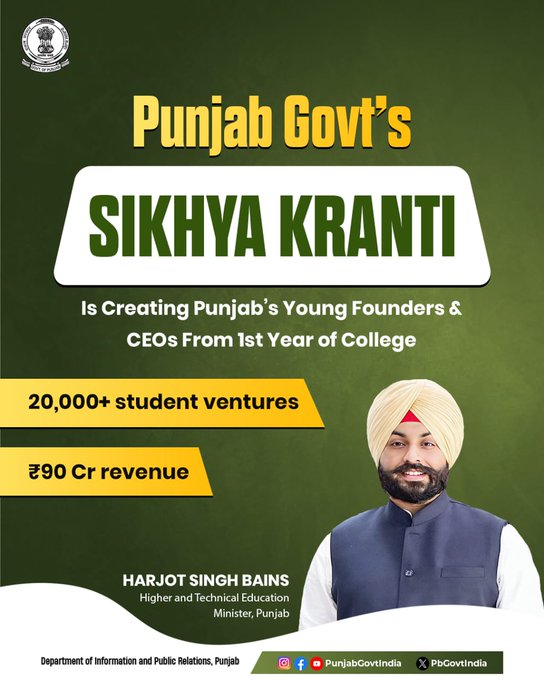
A groundbreaking educational transformation is sweeping across the northern state of Punjab, yielding unprecedented financial and professional results. The highly ambitious Punjab Business Class programme has officially completed its first academic year with stellar success. Spearheaded under the proactive leadership of Chief Minister Bhagwant Singh Mann, this initiative is reshaping the higher education ecosystem. The program aims to systematically foster entrepreneurial mindsets directly within state colleges, technical institutes, and universities.
Additionally, the state government recently released highly detailed, audited figures highlighting the profound impact of this academic policy. In its first operational year alone, the comprehensive curriculum enabled thousands of young minds to launch micro-enterprises. Specifically, more than 20,000 student-led ventures successfully generated an astounding collective revenue of nearly ₹90 crore. This extraordinary financial feat marks a decisive departure from conventional, theory-heavy Indian tertiary education systems.
Moreover, international trade experts and domestic economic analysts are widely praising this highly practical educational approach. By equipping students with immediate, actionable commercial skills, Punjab is aggressively tackling the chronic problem of youth unemployment. The early success proves that modern students can actively contribute to the regional GDP while earning their degrees. Consequently, this structural triumph has ignited a massive wave of optimism among young scholars across the state.
Redefining Modern Classrooms Through Mandatory Practical Training
The foundational core of this rapid success lies in the structured, mandatory layout of the curriculum itself. Introduced as a compulsory two-credit course during the 2025-26 session, the course targeted diverse academic streams. Students pursuing B.Com, BBA, B.Tech, and B.Voc courses were required to clear this practical entrepreneurship module. Furthermore, the administration explicitly extended this mandate to all industrial training institutes (ITIs) and polytechnic colleges. This strategic inclusion ensured that technical and vocational students received identical business management skills.
[The Startup Funnel: Year One Metrics]
│
├──► 95,000 Students Enrolled Across 925 Institutions
├──► 57,000 Students Participated in Practical Activities
├──► 25,693 Brand New Student Businesses Launched
└──► 20,241 Active Ventures Generate ₹90 Crore Revenue
According to official statistics, the extensive programme covered nearly 95,000 students across 925 higher learning institutions. Out of these enrollees, an impressive 25,693 students immediately took the brave leap to establish independent companies. Unlike standard rote-learning methods, the Punjab Business Class programme focuses directly on essential real-world capabilities. Students received hands-on training in identifying market gaps, validating customer demand, setting prices, and running digital marketing campaigns.
Additionally, approximately 57,000 students actively participated in immersive, real-world business simulations and pop-up market events. The dynamic coursework carefully guides them through the legal complexities of business registration and financial accounting. Consequently, young learners acquire the distinct psychological confidence required to handle real capital and navigate fluctuating consumer trends.
From Niche Classrooms to Diverse Market Realities
The sheer variety of business models emerging from these collegiate hubs showcases the immense creativity of local youth. Students rapidly launched commercially viable startups spanning multiple fast-growing modern sectors. These include specialized food and bakery services, automated e-commerce portals, coding agencies, and digital content hubs. Furthermore, substantial growth was observed in localized handicraft manufacturing, beauty services, and highly innovative agritech solutions.
Several remarkable individual success stories have rapidly captured the public imagination across regional media platforms. For instance, a student from Guru Nanak Dev University successfully commercialized a unique matcha beverage startup. Named “Mock in Matcha,” this micro-venture pulled in an impressive individual profit during early operations. Meanwhile, a tech-savvy student from Bathinda created “Skillexus,” a digital career guidance platform serving 2.5 lakh active users.
| Student Founder | Institution Location | Startup Name & Sector | Key Outcome / Revenue |
| Sourav | GNDU, Amritsar | Mock in Matcha (Beverage) | Earned ~₹90,000 initially |
| Sharanveer Singh | MRSPTU, Bathinda | Skillexus (EdTech Platform) | Scaled to 2.5 Lakh+ Users |
| Kamaljeet Singh | Govt ITI, Patiala | KML Mushroom (Agri-supply) | Generated ~₹1.5 Lakh |
| Gaganpreet Kaur | Govt ITI (W), Mohali | Nail Studio by Gagan (Beauty) | Secured ~₹55,000 revenue |
Moreover, vocational students are proving that high-tech machinery is not a prerequisite for successful business development. In Patiala, a determined ITI student launched “KML Mushroom,” a specialized cultivation unit that quickly earned ₹1.5 lakh. Similarly, a female student in Mohali established a home-based nail artistry studio, generating ₹55,000 in months. These tangible examples prove that the Punjab Business Class programme delivers direct economic independence to student founders.
Historic State-Wide Expansion Planned for Next Academic Year
Following these highly encouraging first-year metrics, the state government is rapidly preparing a much larger rollout. Punjab Higher and Technical Education Minister Harjot Singh Bains announced a major policy decision regarding future expansions. Vice-Chancellors from all major state universities have unanimously recommended expanding the course to all undergraduate degree programs. Therefore, starting from the 2026-27 academic session, students pursuing BA, B.Sc., and basic humanities will join the program.
Additionally, Minister Bains emphasized that the primary objective of the state is to completely redefine the historical purpose of higher education. The current administration wants to ensure that colleges nurture a fresh generation of innovators, rather than just awarding paper degrees. Under the umbrella of the ‘Sikhya Kranti’ movement, the state is building a highly sustainable startup ecosystem. This long-term strategy will systematically transform local colleges into active business incubators.
In conclusion, Punjab’s bold educational gamble is paying off handsomely, setting a bright benchmark for other Indian states to emulate. The successful alignment of academic structure, financial awareness, and practical execution has unlocked tremendous economic energy. By providing micro-grants, mentors, and clear institutional support, the state is effectively grooming future CEOs from their very first year of college.