
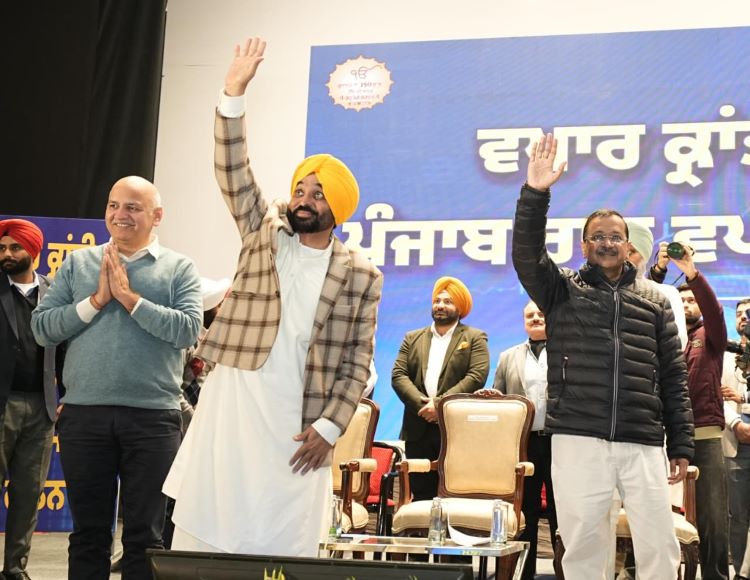
Kejriwal and CM Bhagwant Mann launch Punjab State Traders Commission to end tax harassment, simplify governance and protect shopkeepers statewide.
Punjab Chief Minister Bhagwant Mann and Aam Aadmi Party (AAP) National Convenor Arvind Kejriwal hailed the commission as a crucial step to put an end to years of bureaucratic harassment and indifference experienced by traders during the first meeting of the Punjab State Traders Commission, which was held in SAS Nagar. Shopkeepers will no longer have to rush from office to office since the AAP administration has brought governance right to the marketplace, according to the AAP Chief.
Arvind Kejriwal hailed the initiative as the start of a new age of corporate reform in Punjab, promising to streamline the tax code, put an end to tax terrorism, and eliminate unnecessary red tape. Reiterating the remark, Chief Minister Bhagwant Mann emphasized that shopkeepers are the real patriots who propel the economy and conveyed confidence that the commission will take immediate action to protect the welfare and dignity of traders throughout the state.
“Today, a new beginning is taking place for small shopkeepers, traders, and markets, towards whom no one ever paid attention until now,” said AAP National Convenor Arvind Kejriwal, speaking to the crowd. I extend my sincere congratulations to everyone who has been appointed to these commissions at various levels and given this responsibility. After our government has been in office for four years, I recently noticed a very lovely scene. None of the people seated in this hall are party workers. You are self-sufficient individuals. Some of you represent industry-specific trade groups, such as those for tiles and textiles, while others are presidents of market associations. You all have diverse backgrounds. You are all self-sufficient individuals.
Also read: Pidilite Expands Manufacturing in Punjab with ₹300 Crore Plant, Jobs for 300 Locals
“It is often said that after four years of governance, strong anti-incumbency sets in and people become angry for one reason or another,” he added, reflecting on popular attitude. The Shiromani Akali Dal government came before us, followed by the Congress government. They would endure so much hatred after four years that I doubt the Congress government would have had the guts to hand out microphones in a public setting and tell people to say anything they wanted. They would have been subjected to abuse if the microphone had been passed about during the Congress administration. The microphone would not have been returned and there would have been a great deal of abuse if it had occurred during the Akali Dal rule. Just now, I paid close attention and heard individuals complimenting the work, saying it has been successful for more than four years.
Speaking on how traders are perceived, Arvind Kejriwal stated, “Up until now, traders and businessmen have been viewed with a very negative mindset in our country.” Everybody treated traders like thieves, regardless of the parties or governments in power. Every government believes that they should be plundered because they are robbers. Taxes are one way that the government takes money. We are unable to alter the current Goods and Services Tax (GST) system in its entirety. I hope that when our administration is established at the federal level, you will no longer be subject to GST. A form of tax terrorism is occurring. You are squeezed by the government through taxes on the one hand, and political parties on the other. Only during elections do they remember you to solicit donations and accept bribes over the course of the five years. Every government views traders as robbers. However, it is not how we think.
He went on to share his personal link, saying, “I’m from a trading family. I am aware of the misery that traders endure. You might recall how we used to spend our summer vacations in the village as kids. At the bus stop, my uncle had a grocery store. I would often run the entire store by myself for days during summer breaks. I can relate to a shopkeeper’s suffering. He works day and night, takes enormous risks, makes very little money, pays taxes to the government, gives jobs to others, provides for his family, and uses his earnings to fund all social and humanitarian endeavors in the city or town. Governments still bother him in spite of this. I can relate to your suffering.
“I also understand that no country can progress until it protects even its smallest shopkeeper and provides him with facilities,” the AAP Chief said, tying merchant welfare to national advancement. Everywhere, governments discuss large investments. Like other states, Punjab also has programs like Invest Punjab. That should occur and is not incorrect. They discuss industries that bring in ₹3,000 crore, ₹4,000 crore, or ₹10,000 crore. That is a good thing and ought to occur. However, the modest merchant who operated a grocery store, a garment store, a bread business, a tile store, or stores in tiny marketplaces never received any notice. Now, for the first time, the small business owner doesn’t have to question whether to contact someone based on a recommendation or offer a bribe to have his job done. This must end.
He went on to explain the new commission structure, saying, “We are putting in place a framework that will allow you to join the government. A commission will be established at the state, district, and—above all—constituency levels. Along with the local police and administration, traders will be present at the constituency level commission. They are in charge of approaching each market vendor and scheduling a meeting. These meetings will cover the issues that shopkeepers encounter. Shopkeepers may have personal issues; for example, they may claim to have been running around for months without finishing their work. Market-level issues could include things like damaged roads, a lack of restrooms, problems with drinking water, challenges for vendors and consumers, and even issues with law and order. At that level alone, 90% of these issues will be resolved.
“Some issues will be at the policy level, which these committees will recommend to the state government and get fixed, including new policy suggestions,” Arvind Kejriwal stated in response to questions about policy. For instance, past governments created the OTS strategy but never planned to put it into effect. It was never going to be executed because of the way it was conceived. If we develop policies after consulting with others, they will be put into effect, and you will be notified of them through these commissions.
“I am very happy that all these commissions are being launched by the AAP government,” the AAP Supremo concluded. We aim to finish one round of meetings in all of Punjab’s major and local markets within the first three months. There, issues that can be handled immediately will be fixed, and there, issues that require attention at the state level will be dealt with. The subsequent set of meetings will take place after three months.
Also read: Punjab Makes Medical History: First Liver Transplant at Government Hospital in SAS Nagar
“This is a unique program taking place in Punjab, something that never happened under previous governments,” Punjab Chief Minister Bhagwant Mann remarked in his speech to the crowd. Every person’s potential for growth and success is limitless, and this innovative project was started specifically to benefit small business owners. Arvind Kejriwal formed the AAP to teach the nation what value-based politics meant and to transform politics itself, not to get involved in politics.
The Chief Minister emphasized his government’s people-first policy, stating that serving the people was the only reason he took office, a devotion that is evident in the daily operations. Over 61,000 young people in Punjab have been hired solely on the basis of their qualifications. By closing more than 17 toll plazas, we have helped the average person save around ₹64 lakh per day. The empty offices at these toll plazas will now be transformed into Aam Aadmi Clinics to better serve the public, he said.
According to the Chief Minister, traders and shopkeepers were left struggling with meager incomes, while politicians from conventional parties accumulated enormous personal riches. This was in contrast to past regimes. “I implore business owners to draft a thorough plan to advance the state’s growth and fortify the economy. Every rupee will be used wisely for Punjab’s growth and the welfare of its citizens, he said, adding that government revenue has already increased significantly.
CM Bhagwant Mann discussed Punjab’s social ethos, saying that the holy state has always been at the forefront of aiding those in need. “Punjabis never back down from helping those in need. Those who have embezzled funds intended for religious ceremonies or sacrifices to the Almighty shall not escape punishment. He declared that “exemplary action will be taken against such sinners,” and that the state government is working tirelessly and consistently to ensure the well-being of all societal segments.
“Traders serve the country in the real sense by driving the economy,” the Chief Minister stated, referring to shopkeepers as the country’s actual patriots. Because Arvind Kejriwal worked honestly for the welfare of the average person, those who sold the nation and are now on vacations in far-flung foreign locations have imprisoned him. He added, “By discontinuing programs like MGNREGA, the Union government is working day and night for its industrialist friends while depriving the poor of food.”
The Union government must discharge the rightful portion of revenues that are still owed to the Center, the Chief Minister stated, even though the Punjab government is dedicated to paying salaries to low-income workers. “I had pledged that towns and villages would rule the government rather than just offices. Bhagwant Mann congratulated all commission members on their new roles and expressed confidence that they will serve as development catalysts for Punjab, saying, “That promise has been fulfilled.”
Punjab Prabhari Manish Sisodia, a senior AAP leader, told the audience that the government’s intentions directly affect traders’ wealth. Although traders form the foundation of Punjab’s economy, they were compelled to work from one place to another for many years. This commission was established by the state government to address this. He stated that traders are being genuinely empowered for the first time in the nation.
Also read : Punjab Govt Restores Canal Water to Kandi Belt After 40 Years, Farmers Get Long-Awaited Relief
According to Manish Sisodia, dealers now have the power to help correct the system. Because they share a common background, the commission members are able to relate to the difficulties faced by dealers. “With traders’ concerns being addressed at their doorsteps, this initiative will significantly increase trade and commerce throughout Punjab,” he said, adding that this model will open the door for the implementation of trader welfare policies throughout the nation.
“The Punjab State Traders Commission has been established, and it will accomplish work for the traders and the people directly from within the markets,” Manish Sisodia stated. It will guarantee that even the minor, daily problems of local markets are taken care of and enhance the state of the markets. Shopkeepers frequently deal with issues that they previously had to deal with, and there are other normal tasks associated with local markets that require attention. The government itself will now reach them, so they won’t need to travel anyplace. The general image of local marketplaces will shift, and their state will improve.
Cabinet Ministers Sanjeev Arora, Harpal Cheema, and Aman Arora were among the notable attendees.