
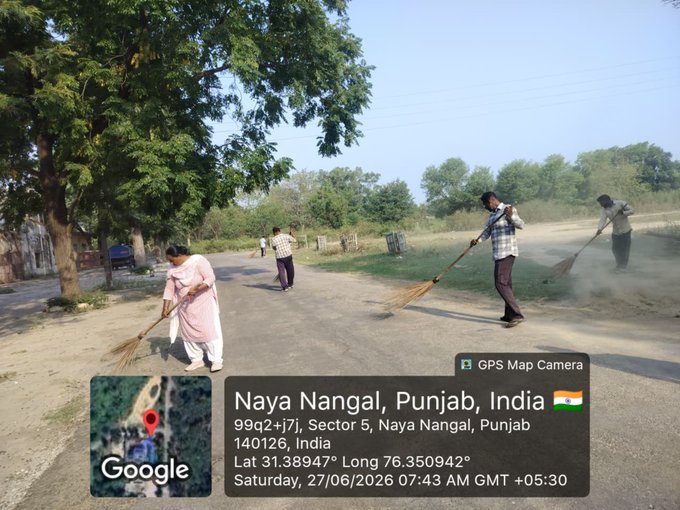
NANGAL — The ongoing implementation of Mission Clean Punjab achieved significant momentum on Saturday. Local Government Minister S. Harjot Singh Bains directly reviewed field operations and commended frontline sanitation workers in Nangal.
The extensive state-wide cleanliness movement operates under the direct leadership of Chief Minister S. Bhagwant Singh Mann. Moreover, this comprehensive sanitation campaign aims to completely modernize municipal waste management frameworks across all regional towns.
Mission Clean Punjab 🧹🇮🇳
Our Safai Sewaks are on duty in Nangal, working tirelessly to keep our city clean and beautiful.📸 Share photos of cleanliness drives from your city and join the movement for a cleaner Punjab!#MissionCleanPunjab pic.twitter.com/mRVYFslEuJ
— Harjot Singh Bains (@harjotbains) June 27, 2026
Through an interactive public update, the minister shared raw field footage of municipal safai sewaks working diligently in Nangal. Consequently, he challenged citizens across all urban divisions to actively document local cleanliness drives within their respective areas.
Frontline Safai Sewaks Lead the Ground-Level Sanitation Drive
The core execution of the ambitious Mission Clean Punjab model relies heavily upon respecting and empowering grassroot sanitation laborers. During his field evaluation, the minister emphasized that these dedicated workers form the absolute backbone of urban public health.
The administration has systematically moved away from managing public services solely through standard bureaucratic files or office rooms. Instead, political leaders are spending extensive morning hours sitting directly with regional cleaning squads to understand operational hurdles.
The minister previously joined safai sewaks over roadside tea sessions during unexpected visits to major municipal corporation sectors. These personal interactions allowed frontline teams to share practical feedback regarding safety equipment shortages and sewer blockages directly.
The minister reiterated that establishing labor dignity remains a non-negotiable prerequisite for achieving pristine, garbage-free urban environments. Therefore, the department is prioritizing the timely distribution of modern protective gear and advanced cleaning apparatus to all staff.
The city of Nangal is currently witnessing comprehensive cleaning operations across all major public intersections and residential zones. Frontline crews are working systematically to elevate local visual aesthetics while eliminating dangerous, open waste-dumping grounds permanently.
“Our dedicated safai sewaks are on duty in Nangal, working tirelessly every single day to keep our city clean and beautiful,” Minister Harjot Singh Bains highlighted to praise the municipal workforce.
Strict Morning Field Mandates for All Civic Officials
To maintain high execution speeds, the ministry introduced a strict, technology-driven monitoring framework across every municipal council. Every single senior civic official must actively conduct on-ground field inspections daily between 7:00 AM and 8:00 AM.
This mandatory rule applies directly to Municipal Commissioners, Additional Deputy Commissioners, and local Executive Officers without exception. Furthermore, the department utilizes a specialized, AI-integrated mobile application to verify the precise live locations of field supervisors.
The minister personally conducts random video conferences during these early hours to inspect progress across different districts. Officers who fail to show documented visible improvements face immediate administrative consequences, including formal show-cause notices.
The state government split every urban local body into highly organized, ten-kilometer operational zones. Each designated sector falls under the direct personal responsibility of a specific nodal officer to ensure absolute accountability.
This rigorous field layout eliminates traditional bureaucratic delays regarding simple public complaints. If a specific neighborhood continues to display poor sanitation standards, the assigned supervisory officer faces direct disciplinary action.
Pre-Monsoon Infrastructure Audits and Safety Deadlines
The intensive focus of Mission Clean Punjab has recently shifted toward urgent pre-monsoon safety preparations. The department conducted a comprehensive state-wide infrastructure audit, which exposed exactly 1,451 critical gaps in regional sewerage networks.
To prevent tragic waterlogging accidents, the minister set a strict, non-negotiable June 30 deadline to close all open manholes. Engineering wings have already successfully rectified more than 1,000 hazardous spots across multiple high-traffic zones.
Additionally, municipal bodies are deploying specialized hybrid cleaning machinery, including automatic shrub-cutters and high-power suction units. These mechanical systems clean extensive highway stretches in a single pass, removing dense silt accumulation rapidly.
The department also established 24×7 emergency “War Rooms” inside every major city to process citizen complaints instantly. This integrated approach ensures that sudden sewer overflows or drainage failures receive immediate engineering attention.
By blending strict administrative oversight with profound respect for frontline laborers, the state is building a sustainable model. The collaborative effort guarantees that public spaces remain remarkably clean, safe, and resilient against changing seasonal demands.