
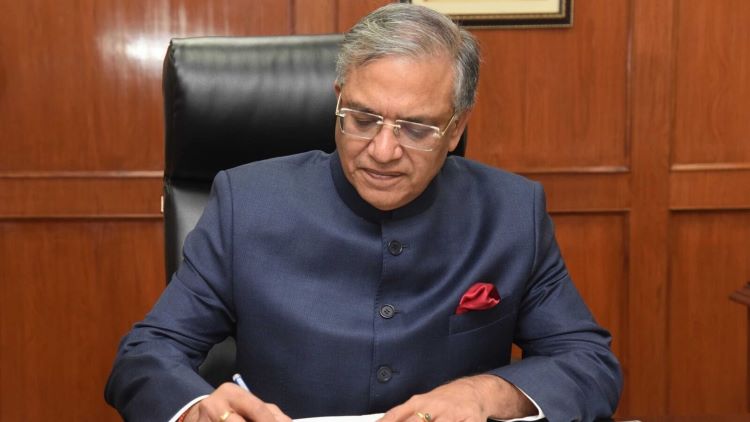
India elected 2026 chairman of International IDEA Council; CEC Gyanesh Kumar to lead IICDEM conference on democracy and election management.
The International Institute for Democracy and Electoral Assistance (IDEA) Council of Member States has elected India as its 2026 chairman for a one-year term. India’s Chief Election Commissioner, Gyanesh Kumar, will serve as the Council’s chairman.
Haryana Chief Electoral Officer A. Sreenivas announced that a three-day India International Conference on Democracy and Election Management (IICDEM), with a focus on democracy and election management, is being organized from January 21 to 23 at Bharat Mandapam, New Delhi, during a press conference held at his office today. The India International Institute of Democracy and Election Management (IIIDEM) will sponsor the conference.
India is one of the 35 founding nations of International IDEA, he said, which was founded in 1995. Sweden’s Stockholm is home to the organization’s headquarters. According to A. Srinivas, the conference’s subject is “Democracy for an Inclusive, Peaceful, Resilient and Sustainable World,” which is consistent with India’s long-standing belief that “the world is one family,” or Vasudhaiva Kutumbakam. The topic embodies the inclusive, resilient, and sustainable development ideals of India.
The conference, he continued, will offer a crucial forum for exchanging experiences, collaborating on projects, and promoting global leadership in democratic and electoral advances. Discussions on model standards and best practices in election management will take place at the conference, which will also cover the worldwide issues that Election Management Bodies (EMBs) face. The two interrelated pillars of India’s Chairmanship priorities—reimagining democracy for the future and independent and competent election management bodies for sustainable democracy—will serve as the foundation for the conference’s thematic priorities.
Also read: Haryana Health Minister Arti Singh Rao Announces Recruitment of 64 Dental Surgeons
A number of important election administration topics will be discussed during the course of the three-day conference by leaders of Election administration Bodies, election specialists, practitioners, and academicians. Voter registration, political engagement, election campaign regulation, voting and tallying procedures, and electoral technology are some of these. Future topics that will be covered include artificial intelligence, disinformation, risk management, sustainability, and democratic participation.
In addition to delegates from over 30 countries through their missions in India, over 40 Election Management Bodies from across the world will participate in the meeting. Election experts, academicians from reputable colleges and institutes, and leaders and senior officials of Election Management Bodies are among the approximately 500 national and foreign delegates that will be present. In addition, the conference will include professionals from the domains of law, technology, management, and communication, as well as experts from IITs, IIMs, and National Law.
Over thirty-five sessions are scheduled for the conference, according to A. Sreenivas. Each State and Union Territory’s Chief Electoral Officer has been tasked with facilitating conversations on a range of topics, the results and lessons learned of which will be shared on the global stage. Electronic voting machines (EVMs) and postal ballots are two aspects of the voting process that Haryana has been given as its topic. In cooperation with the heads of the Election Management Bodies of the Netherlands and Fiji, Haryana authorities will conduct a year-long research visit on this topic, examine their voting procedures, and compile a comprehensive report. The presentation by Haryana will take place in the MR-7 Hall at Bharat Mandapam on January 22, 2026, at 4:00 PM.
According to the Election Commission of India’s instructions, he added, the Chief Electoral Officer and other officials will represent Haryana. The Haryana delegation will also include Dr. Nidhi from Maharshi Dayanand University’s Faculty of Management in Rohtak, Dr. Subodh Vishnu Sharma from IIT Delhi, legal professionals, and media representatives.
In response to a question on the Special Intensive Revision (SIR) of electoral records, Sh. A. Sreenivas stated that Haryana is making initial preparations in compliance with the recommendations made by the Indian Election Commission. In March and April, the Commission may issue orders to finish the exercise. Family-wise mapping is being carried out by Booth Level Officers (BLOs), and so far, 58.18 percent progress has been made.
He reported that 1,20,70,496 voters have been mapped out of the 2,07,47,275 registered voters in Haryana as of 2025. There are 20,629 BLOs currently working door-to-door as part of this exercise. BLOs from the districts of Faridabad, Panchkula, and Gurugram will soon participate in training programs for the first phase.