
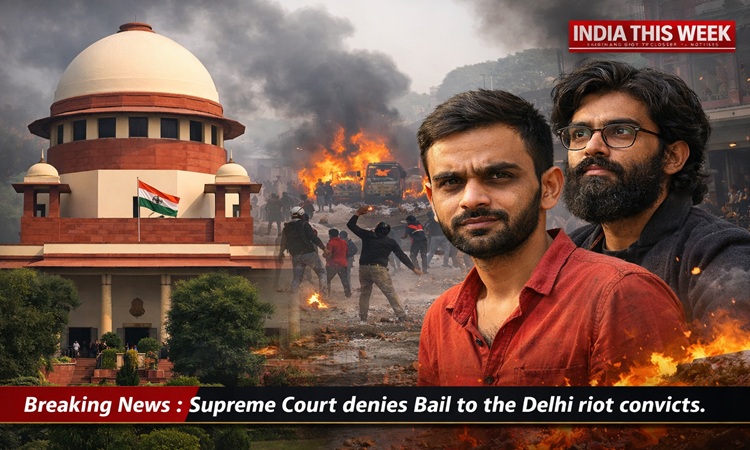
NEW DELHI : The Supreme Court of India today denied bail to Umar Khalid and Sharjeel Imam in the larger conspiracy case linked to the 2020 Delhi riots. The court held that both accused stand on a qualitatively different footing compared to other co-accused, citing the nature of allegations under the Unlawful Activities (Prevention) Act (UAPA) and the Indian Penal Code.
However, the apex court granted bail to five other accused: Gulfisha Fatima, Meeran Haider, Shifa Ur Rehman, Mohammad Saleem Khan, and Shadab Ahmed. The February 2020 violence left 53 people dead and more than 700 injured.
Why the Supreme Court Denied Bail
The bench said Khalid and Imam face graver allegations compared to the other accused. According to the prosecution, both played a central role in the alleged conspiracy behind the riots. The court referred to Section 16 of the UAPA, which deals with terrorist acts resulting in death and allows punishment up to life imprisonment or death.
The judges noted that the threshold for bail under UAPA is higher. Therefore, courts must examine whether the accusations appear prima facie true. On this test, the bench found sufficient grounds to deny bail at this stage.
The accused had challenged a September 2 order of the Delhi High Court, which earlier rejected their bail pleas in the conspiracy case.
READ MORE : Delhi Police calls 2020 Delhi riots a “regime-change” plot
Background of the Delhi Riots Case
The violence erupted in Northeast Delhi during protests against the Citizenship (Amendment) Act (CAA) and the proposed National Register of Citizens (NRC). According to police, the riots were not spontaneous. Instead, they claimed the violence was pre-planned and orchestrated to challenge India’s sovereignty.
The Delhi Police argued that speeches and actions of key accused triggered coordinated violence. Investigators said Sharjeel Imam’s speeches could be attributed to other accused and used as evidence of conspiracy.
Arguments from Both Sides
The court reserved its verdict on December 10 after extensive hearings. The prosecution was represented by Tushar Mehta and S V Raju. They strongly opposed bail, stressing the seriousness of charges.
Senior advocates Kapil Sibal, Abhishek Singhvi, Siddhartha Dave, Salman Khurshid, and Sidharth Luthra appeared for the accused.
Imam’s counsel argued that he was arrested on January 28, 2020, before the riots began. They claimed his speeches alone cannot establish criminal conspiracy. Imam also told the court he was unfairly labelled a dangerous intellectual terrorist without trial or conviction.
Bail Granted to Five Accused
While denying bail to Khalid and Imam, the court allowed bail for five others. The bench said their roles appeared limited at this stage. Therefore, continued custody was not justified under the same standard.
Legal experts say the split verdict shows the court’s attempt to balance civil liberties with national security concerns. However, the denial to Khalid and Imam signals a tough stance in UAPA cases in Delhi Riots case.
International Reactions and US Lawmakers’ Letter
The case has drawn international attention. Eight United States lawmakers wrote to the Indian government seeking a fair and timely trial for Umar Khalid. The letter was addressed to Vinay Kwatra.
The signatories included Jim McGovern, Jamie Raskin, Chris Van Hollen, Peter Welch, Pramila Jayapal, Rashida Tlaib, Jan Schakowsky, and Lloyd Doggett.
Supporters of Khalid argue the prolonged incarceration raises human rights concerns. However, Indian authorities maintain that the judicial process is ongoing and independent.
What Lies Ahead
The trial in the larger conspiracy case continues. The denial of bail means Khalid and Imam will remain in custody. Meanwhile, the bail granted to others may shape future arguments in similar UAPA cases.