
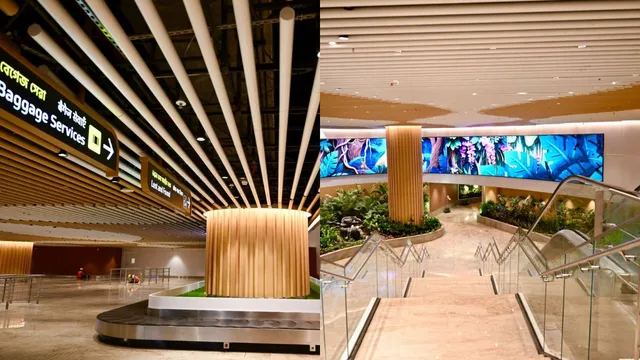
PM Modi inaugurates Guwahati’s new LGBI Airport terminal, Northeast India’s largest, with nature-inspired design and world-class facilities.
Today, Lokapriya Gopinath Bordoloi International (LGBI) Airport in Guwahati’s new terminal building will be opened by Prime Minister Narendra Modi. The new terminal, which cost over Rs 4,000 crore to build, is touted as the biggest airport terminal in Northeast India and a major force behind connectivity, travel, and economic expansion.
Around three o’clock in the afternoon, the prime minister will land in Guwahati. He is in Assam for two days, including the inauguration.
The new terminal is being marketed as the biggest airport terminal in Northeast India and has already generated a lot of conversation on social media due to its unique architecture and design. Designed to accommodate the region’s expanding aviation and connectivity needs, it is seven times larger than the current terminal.
Also read : Assam: Sairang-New Delhi Rajdhani Express Hits Elephants, 8 Dead, 1 Injured
By 2032, the terminal should be able to accommodate 13.1 million people annually if it is completely functioning. According to officials, it is intended to serve as a hub for regional connectivity, enhancing ties between Southeast Asia and India. The facility will have the largest capacity in the Northeast, able to handle up to 34 air traffic movements per hour. According to sources, one of the most sophisticated Instrument Landing Systems (ILS) will also be installed.
Architecture Inspired by Nature
Despite the importance of its size and technology, the terminal’s architecture has garnered the most interest. Northeast India’s natural and cultural legacy is a major influence on the architecture and interior design. The interiors draw inspiration from the Northeast’s landscapes, honor the region’s rare orchids, and capture the warmth and texture of bamboo. It was created with the concept “Bamboo Orchids” and is the first airport terminal in India with a natural motif.
The Brahmaputra River’s passage through the state and native orchids, known locally in Assam as Kopu Phool, are the main design motifs. The terminal has almost 2,000 plant varieties, a special area modeled after Kaziranga National Park, and artifacts that symbolize Majuli Island.
The terminal’s bamboo vault, which gives the structure a unique personality, is its most notable feature. The design makes considerable use of bamboo, which is frequently considered a cultural emblem of the Northeast. The vault area was designed as a multipurpose cultural hub to encourage cross-cultural interaction and community involvement.
About 140 metric tonnes of locally grown Northeast bamboo are used in the design, which also includes 57 orchid-inspired columns that mirror the Kopou flower, japi symbols, the famous rhino symbol, and verdant landscapes inspired by Kaziranga.
Arriving passengers are treated to an immersive, forest-like experience in a unique “Sky Forest” that features around one lakh plants of native species.
Integration of Digital
With significant improvements to the runway, airfield systems, aprons, and taxiways, the recently finished Integrated New Terminal Building, which spans roughly 1.4 lakh square meters, is built to accommodate up to 1.3 crore people per year.
Passenger ease and technology integration are priorities at the new terminal. To facilitate passenger flow, it features 14 entry points, including four DigiYatra gates. To guarantee smooth and effective travel, amenities like automated baggage handling, fast-track immigration, full-body scanners for quick, non-intrusive security inspections, and AI-driven airport operations are in place.
PM Modi will also speak at public gatherings and lay the groundwork for a number of initiatives during his two-day visit.In order to honor the sacrifices of the historic Assam Movement—a six-year people’s movement that reflected the collective commitment for an Assam free of foreigners and the preservation of the State’s identity—the Prime Minister will travel to the Swahid Smarak Kshetra.