
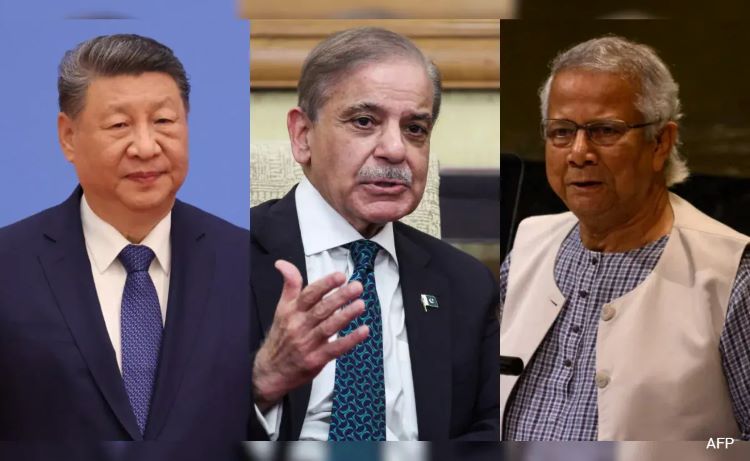
Pakistan aims to expand its China-Bangladesh bloc to counter India, but experts and Yogi govt voices say no South Asian nation will risk excluding New Delhi.
Pakistan is seeking to contest India’s longstanding dominance in South Asian geopolitics through a new initiative to modify regional alliances. Pakistan’s Deputy Prime Minister Ishaq Dar recently stated that Islamabad is actively working to expand its trilateral initiative with Bangladesh and China to encompass additional regional countries and beyond.
However, considering India’s economic strength and expertise in crisis management, analysts contend that no country would risk aligning with a coalition that omits New Delhi.
Pakistan’s Proposal
Last week, Pakistan’s Deputy Prime Minister Dar advocated for the establishment of a new regional organization to supersede the long-inactive South Asian Association for Regional Cooperation (SAARC). His remarks are made in the context of increasing India-Pakistan tensions, particularly following a four-day military confrontation between the two nuclear-armed states in May.
Dar asserted that South Asia can no longer sustain itself within “zero-sum mindsets, political fragmentation, and dysfunctional regional architecture,” as he proclaimed Islamabad’s intention to promote “open and inclusive regionalism.”
He indicated that Pakistan supports emerging multilateral platforms beyond SAARC and stated that Islamabad envisions a South Asia where cooperation supersedes divisions, economies develop synergistically, disputes are settled peacefully in accordance with international legitimacy, and peace is preserved with dignity and honor.
Also read : India, US Push Forward Bilateral Trade Agreement as Deputy Ambassador Arrives
Pakistan, Bangladesh, and China established a trilateral framework earlier this year to promote mutual cooperation in areas of shared interest. In June, the three nations convened a summit in Kunming, marking its inaugural occurrence.
This concept can be extended and duplicated. As I have previously stated, groups with flexible structures—covering topics from the economy to regional priorities—must not and should not be subjected to anyone’s inflexibility, ” Dar, who also serves as Pakistan’s Foreign Minister, stated, in a subtle allusion to India.
SAARC has become largely inactive amidst escalating India-Pakistan tensions in recent years.
What is SAARC
SAARC, the principal regional alliance in South Asia, was founded in 1985 during a summit held in Dhaka. Its seven founding members comprised India, Pakistan, Bangladesh, Bhutan, the Maldives, Nepal, and Sri Lanka. Afghanistan also became a member of the alliance in 2007.
According to its official website, the primary objective of the alliance is to foster economic growth, social advancement, and cultural development within the South Asia region.
Despite its ambitious goals, the SAARC convened its most recent summit in 2014. The upcoming summit of the alliance, scheduled for 2016 in Islamabad, was canceled in response to the terrorist assault in Uri, which India attributed to Pakistan. New Delhi has consistently asserted that Islamabad’s endorsement of cross-border terrorism renders SAARC meetings impractical.
Although still a member of SAARC, New Delhi has redirected its attention toward the BIMSTEC (Bay of Bengal Initiative for Multi-Sectoral Technical and Economic Cooperation) grouping, which precludes Pakistan from regional collaboration.
The Significance of South Asian Collaboration
According to the most recent data, the SAARC nations constitute over two billion of the global population, rendering South Asia the most densely populated region in the world. However, intra-regional trade within South Asia stands at merely $23 billion, accounting for approximately 5 percent of the region’s total commerce, according to World Bank data.
The deficiency in regional connectivity is identified as a primary factor contributing to the region’s limited trade relations.
The Washington-based institution estimated that South Asian countries could facilitate trade valued at $67 billion—three times their current level—if they were to lower trade barriers.
Is Pakistan’s Strategy Feasible?
According to Lahore-based academic Rabia Akhtar, Pakistan’s proposal at this juncture is probably “more aspirational than operational”.
But it indicates Pakistan’s intention to diversify and redefine regional cooperation frameworks, particularly at a time when SAARC remains immobilized, Akhtar, director of the Centre for Security, Strategy and Policy Research (CSSPR) at the University of Lahore, told Al Jazeera.
However, according to Akhtar, the feasibility of the proposal will be contingent upon two factors.
First, it must be considered whether prospective states recognize the practical benefits of smaller, issue-specific groupings at a time when conventional frameworks are at a standstill; and second, whether participation does not incur political costs in relation to India, he stated.
This is not the initial instance in which Pakistan has sought to redefine the landscape of regional collaboration. Islamabad, in conjunction with Beijing, undertook a comparable initiative in June.
At that time, Swaran Singh, a professor of international relations at Jawaharlal Nehru University in New Delhi, observed that India’s standing in South Asia remains invulnerable.
In an interview with the South China Global Post, he observed that India’s population is seven times greater than Pakistan’s, its defense budget is five times larger than Islamabad’s, and its economy is twelve times more substantial. Its foreign exchange reserves may also surpass those of Pakistan by a factor of 45.
Also read : Microsoft Commits $17.5 Billion to India for AI, Cloud, and Skill Development
This should provide us with sufficient insight into the future of any South Asian regional cooperation initiatives aimed at excluding India from their formulation, he stated.
Another JNU associate professor, Shantesh Kumar Singh, observed that some smaller nations in the region, such as Nepal and Bhutan, rely heavily on access to India to meet many of their export requirements. During times of crises, including disaster response and vaccine diplomacy amid the Covid-19 pandemic, New Delhi has demonstrated itself as an essential leader.
India must persist as a responsible and cooperative leader, promoting trust and inclusive collaboration to prevent external powers from determining South Asia’s regional structure and objectives, he stated. He emphasized that Delhi’s active engagement is vital for establishing a balanced regional order, especially considering China’s expanding strategic influence.
He remarked that the absence of Delhi could result in SAARC becoming “fragmented and underfunded.”