
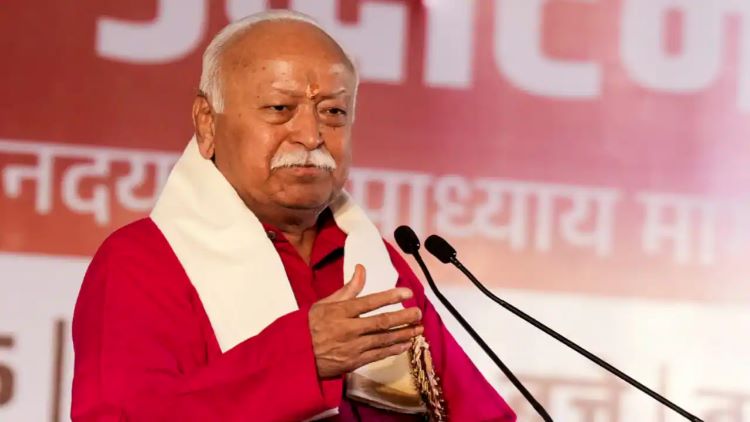
RSS chief Mohan Bhagwat urges unity beyond caste and language, highlights family bonds, civic duty, and equitable access to public resources.
New Delhi: Mohan Bhagwat, the leader of the Rashtriya Swayamsevak Sangh (RSS), emphasized that everyone is a part of the country and urged people to overcome differences based on caste, language, and wealth. Speaking at a Hindu Sammelan at Sonpairi village in the Raipur region of Chhattisgarh, he urged society to adopt an inclusive stance and emphasized that the first step to achieving true harmony is to eradicate prejudice. Bhagwat stated that all Hindus should have access to public facilities such as temples, water bodies, and cremation grounds, and that the nation should be seen through the lens of togetherness.
I own all of India: The Bhagwat
Bhagwat advocated treating everyone as if they were their own. “Everyone owns the entire nation, and this spirit embodies genuine social peace…According to news agency PTI, he stated that no one should be evaluated based on their caste, money, geography, or language. Referring to this strategy as samajik samrasta, Bhagwat emphasized the need of reestablishing family bonds and encouraged families to set aside at least one day per week for group activities including meals, prayers, and deep conversations. He called these discussions “mangal samvad.”
Loneliness can be avoided through family interaction.
Bhagwat emphasized the growing problem of loneliness in contemporary society and claimed that consistent family interaction might help people avoid bad habits. “When people are lonely, they frequently develop unhealthy habits. This can be avoided with regular family communication and involvement,” he stated. Additionally, he discussed kutumb prabodhan and urged people to consider the amount of time and energy they devote to society and the country on a daily basis.
Also read: India Rings in New Year 2026 Amid Heightened Security and Partial Closures
Everyone must have equitable access to temples and water supplies.
Bhagwat emphasized that all Hindus must have access to fundamental common areas. “All local resources and facilities, water sources like ponds and wells, places of worship such as temples and monasteries, arrangements for religious activities and even final rites after death, should be open to all Hindus,” he stated. The head of the RSS emphasized that unity should never entail confrontation and stated that all efforts should be achieved via communication and understanding.
Civic discipline and environmental responsibility
Concerned about environmental harm and global warming, Bhagwat urged individuals to start conserving by taking small, individual acts. He talked about growing more trees, cutting back on single-use plastic, implementing rainwater collecting, and conserving water. In addition, he promoted the use of mother tongues at home, respect for Indian dress, and support for Swadeshi by purchasing locally produced things, unless imported items, like medications, are required. Bhagwat also demanded rigorous discipline, constant reading of the preamble, obedience to the Constitution, and basic civic obligations. According to him, these ideals must coexist with customs like honoring elders and lending a hand to those in need.
The work of the RSS has spread throughout India.
Bhagwat reflected on the Rashtriya Swayamsevak Sangh’s career, stating that it started as a little shakha in Nagpur and has since grown throughout the nation. “RSS volunteers can be found everywhere in Kashmir, Mizoram, Andaman, Sikkim, Kutch and across the north, south, east and west of India.” Bhagwat praised Dr. Keshav Baliram Hedgewar, the organization’s founder, for his lifetime commitment to the cause and credited him with its growth. He went on to say that spreading the Sangh’s work throughout India is what really counts, not reaching 100 years.