
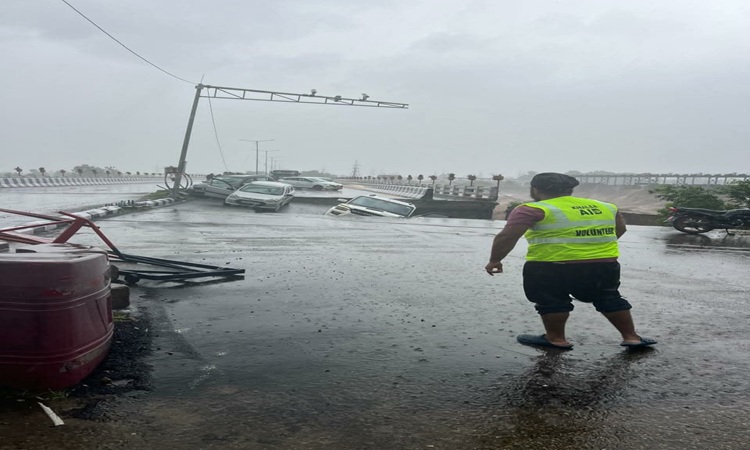
Torrential Rains Cause Havoc Across J&K
Jammu and Kashmir continues to reel under the impact of relentless rains, which entered their fourth consecutive day on Wednesday, August 27. The downpour has led to flash floods, landslides, and widespread devastation, forcing authorities to launch massive rescue operations.
According to officials, the Indian Air Force (IAF) has been deployed to assist in relief efforts. Sources confirmed that C-130 and IL-76 aircraft are ready to fly out from Hindan airbase with National Disaster Response Force (NDRF) teams and essential supplies. Helicopters, including Chinook and Mi-17 V5, have been stationed at forward bases in Jammu, Udhampur, Srinagar, and Pathankot to aid the evacuation process.
The non-stop rains have caused rivers and streams across the region to swell dangerously. Many low-lying areas in Jammu have been submerged, forcing families to flee to safer ground. Officials warned that several water bodies have risen well above the danger mark, raising fears of further flooding in the coming days.
Landslide Hits Vaishno Devi Route
The sacred pilgrimage to Mata Vaishno Devi shrine was brought to a halt after a massive landslide struck the route on Tuesday afternoon. The winding path leading to the shrine atop the Trikuta hills has been left devastated, with debris and mudslides blocking movement.
Initial reports suggest that at least 30 people have lost their lives after a section of the mountainside collapsed around 3 pm. Emergency teams have rushed to clear the path and rescue stranded devotees. Authorities have suspended the pilgrimage until conditions improve, citing safety concerns.
Rescue teams, including local police, paramilitary personnel, and volunteers, are working round-the-clock to restore access. Helicopters have also been pressed into service to evacuate those stranded along the route.
Rivers Cross Danger Level
The situation remains grim as major rivers in both Jammu and Kashmir divisions continue to flow above danger levels. Officials confirmed that rivers Tawi, Chenab, Ujh, Ravi, and Basanter have surged several feet higher than safety limits.
In the Kashmir valley, the Jhelum River breached the 21-foot flood-alert mark at Sangam in Anantnag district overnight. By Wednesday morning, it was only two feet below the 18-foot alert level at Ram Munshi Bagh in Srinagar. Authorities fear that if rains continue, Srinagar could face severe flooding similar to the devastating floods of 2014.
Meanwhile, dozens of villages in low-lying regions remain cut off as roads have been submerged or destroyed. Officials are prioritizing evacuation in the most affected areas, with relief camps being set up for displaced families.
Communication Woes Add to Crisis
Chief Minister Omar Abdullah expressed concern over the breakdown in communication services across the union territory. Posting on X (formerly Twitter), he wrote, “Still struggling with almost non-existent communication. There is a trickle of data flowing on Jio mobile, but no fixed line WiFi, no browsing, almost no apps. WhatsApp struggles with anything more than short text messages.”
The Chief Minister compared the situation to the “terrible days of 2014 and 2019” when floods and security clampdowns left residents isolated. He acknowledged that poor connectivity was hampering coordination of relief work.
On Tuesday, Abdullah had spoken to Union Home Minister Amit Shah to brief him on the scale of devastation. He said that efforts were underway to restore communication lines at the earliest. However, the closure of Jammu airport delayed his planned visit to the flood-hit areas. He assured citizens that he would reach Jammu on the earliest available flight while staying in constant touch with ground teams.
Relief Efforts and Way Forward
The J&K administration has deployed teams from disaster management, health, and revenue departments to assist affected residents. Relief camps are being set up in safe zones, where stranded families are being provided food, water, and medical assistance.
Officials emphasized that the immediate priority is to evacuate vulnerable populations, particularly women, children, and the elderly, from inundated areas. The IAF’s deployment of advanced transport aircraft and helicopters is expected to speed up these efforts.
Experts, however, have raised concerns about the region’s fragile infrastructure and its inability to withstand repeated climate-induced disasters. Calls are growing for long-term investments in flood management systems, including stronger embankments, better drainage networks, and early warning mechanisms.
As the rains show no sign of relenting, the people of Jammu and Kashmir face yet another reminder of the region’s vulnerability to natural calamities. Authorities are urging citizens to stay alert, avoid unnecessary travel, and follow official advisories until conditions stabilize.