
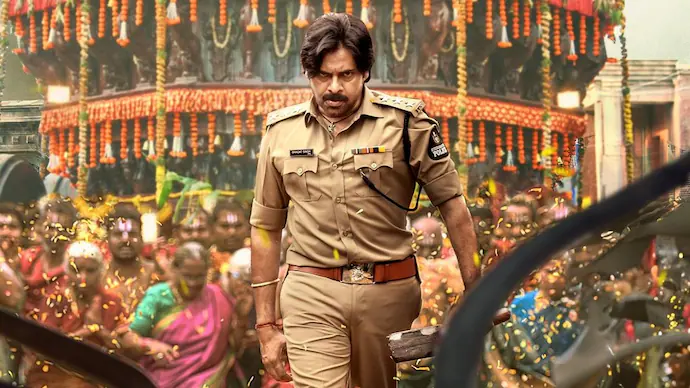
Ustaad Bhagat Singh Review : The latest Ustaad Bhagat Singh, starring Pawan Kalyan and directed by Harish Shankar, has hit theatres with high expectations. After years of commercial cinema relying on star appeal over storytelling, audiences were curious whether this film would break the trend or fall into the familiar pattern of nostalgia-driven mass entertainers.
Story and Narrative
The film follows Ustaad Bhagat Singh, a character built using every familiar commercial template—tragic past, philosophical one-liners, moral high ground, and a personality designed to fit every situation. The narrative attempts to tackle terrorism, politics, drugs, and nationalism, but these elements feel like checkboxes rather than integral story points. As a result, the plot emerges as a series of moments stitched together rather than a compelling narrative.
According to the Ustaad Bhagat Singh review, the writing feels dated, with scenes that rarely flow naturally. Conversations often appear staged, serving punchlines or moral lectures rather than meaningful interaction. Dialogues try to emulate the rhythm of Pawan Kalyan’s earlier hits like Gabbar Singh, but they lack the timing and wit that made those films memorable.
Performances and Star Power
Pawan Kalyan remains the highlight of the film. After a series of restrained roles, he appears relaxed and playful, particularly in lighter stretches reminiscent of his Gabbar Singh phase. His charm and screen presence carry several dull portions, offering moments of engagement even when the writing falls short.
Also read : Border 2 OTT Release Announced: Fans Can Stream from March 20
However, the Ustaad Bhagat Singh review notes that repetitive quirks—like shooting bullets into the ground at odd intervals—quickly become distracting rather than endearing. Supporting actors, including Sreeleela and Raashii Khanna, contribute in familiar ways but fail to leave a lasting impact, while R. Parthiban’s antagonist lacks depth, weakening the central conflict.
Technical Aspects
On the technical front, the film is serviceable. Devi Sri Prasad’s music works in select songs but overall fails to elevate the narrative. The background score follows loud, familiar patterns, while the cinematography feels conventional in most parts. Even the film’s design moments, like the interval card, appear more inventive than the story itself, highlighting the dated approach.
Overall Verdict
The Ustaad Bhagat Singh review concludes that the film reflects a recurring pattern in commercial cinema: star-driven films relying heavily on nostalgia and presence while expecting audiences to overlook weak writing and outdated storytelling. While fans of Pawan Kalyan may enjoy fleeting moments, the film offers little to those seeking narrative coherence or innovation.
On the whole, Ustaad Bhagat Singh is a routine commercial entertainer. It depends almost entirely on Pawan Kalyan’s presence to sustain audience interest, delivering sporadic highs for fans but failing to provide a compelling cinematic experience for general viewers.