
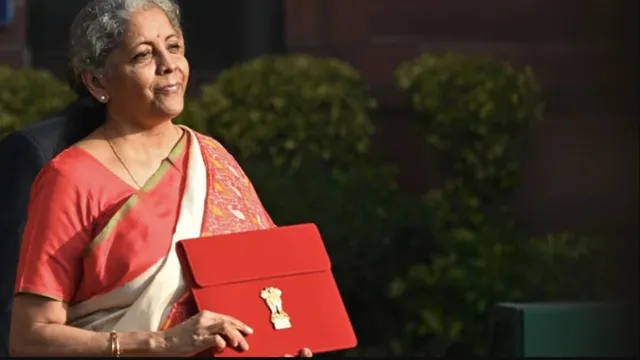
Union Budget 2026 likely to be presented on February 1, Sunday. Finance Minister Nirmala Sitharaman set for her eighth consecutive budget.
The date of the Union Budget 2026 will be confirmed soon, with strong indications that the government will keep to the regular February 1 deadline.
According to sources quoted by Moneycontrol, the Cabinet Committee on Parliamentary Affairs (CCPA) is anticipated to make a final decision on the topic as early as today.
While an official notification from the Parliamentary Affairs Ministry is still needed, internal government preparations indicate that February 1 remains the working assumption for the Budget presentation, despite the fact that the date falls on a Sunday.
February 1 Emerges as the Front Runner
According to the newspaper, officials have proposed maintaining the long-standing tradition of presenting the Union Budget on February 1.
According to CNBC-TV18, the finance ministry is planning to table the budget on that specific day.
At this point, a significant divergence from the standard schedule is improbable. Ministries and departments involved in the yearly financial exercise are continuing to prepare without alteration, indicating that February 1 remains the favored date.
In recent years, the Centre has generally preferred early-February budget presentations. This gives Parliament enough time to consider proposals and permits policy changes to take effect at the start of the new fiscal year in April. Officials stated that changing the date now would require considerable logistical changes, making a revision unlikely until unavoidable.
Also read: PM Modi Holds Telephonic Talk with Israeli PM Netanyahu, Strengthens Strategic Partnership
Weekend budgets are no longer unusual.
The possibility that February 1 falls on a weekend is not viewed as a barrier. Budget presentations on non-working days have precedent. Finance Minister Nirmala Sitharaman presented the Union Budget on a Saturday in 2020. Previously, former Finance Minister Arun Jaitley presented the Budgets for 2015 and 2016 on February 28, both Saturdays.
In reality, presenting the Budget on a weekend has been considered as advantageous, reducing disturbance to financial markets while assuring unbroken legislative processes.
Over the past decade, governments have prioritized regularity in the Budget calendar. Industry organizations, investors, and state governments have grown accustomed to receiving early clarification on taxation, spending objectives, and reform proposals well before the new fiscal year begins.
A significant milestone for Nirmala Sitharaman
If the Union Budget 2026 is presented on February 1, Finance Minister Nirmala Sitharaman will achieve a huge personal milestone. The forthcoming exercise would be her eighth straight budget and the 80th Union Budget since India’s independence.
Sitharaman presented her first full budget in 2019 after taking over as finance minister. This was followed by annual budgets for 2020, 2021, 2022, and 2023. In 2024, she submitted an interim budget prior to the general elections, followed by the complete Union Budget for 2024-25 in July. The 2025 Budget was similarly delivered on February 1, confirming a pattern that the government appears eager to perpetuate.
Continuing the February 1 tradition for Budget 2026 would demonstrate the Centre’s preference for fiscal continuity and stability.
Why the Budget Date is Important Beyond the Headlines
While the budget presentation day captures the public’s attention, the entire Budget Session of Parliament is equally important. The session usually begins with the presentation of the Economic Survey, followed by in-depth discussions, debates, and votes on spending requests and taxing initiatives.
The Budget Session timetable is normally finalised following negotiations with political parties and parliamentary leadership. This approach explains why formal announcements are often made around the start of a session.