
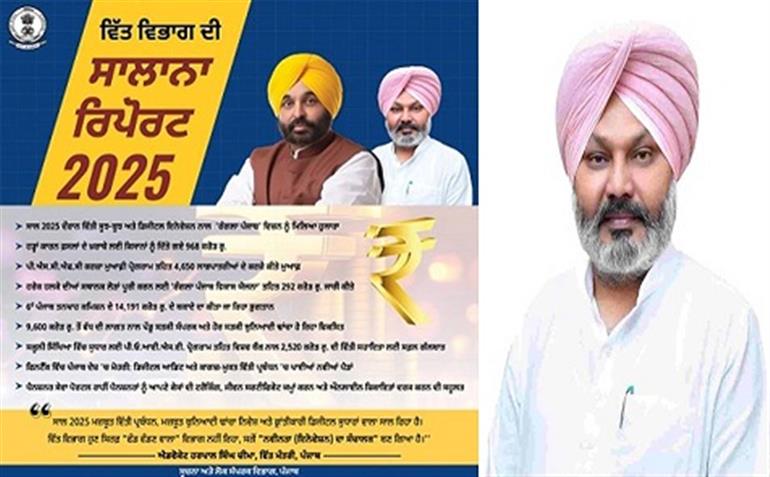
FM Harpal Singh Cheema reports record fiscal discipline, digital reforms, and major infrastructure, health, and education projects in Punjab for 2025–26.
Punjab Finance Minister Harpal Singh Cheema highlighted a year of strong fiscal management, record-breaking infrastructure spending, and historic digital changes in the Finance Department’s annual year-end report. He underlined that the Finance Department is now a “driver of innovation” as well as a “distributor of funds.”
The finance minister, Harpal Singh Cheema, emphasized the Punjab government’s “people-first” strategy, which was led by chief minister Bhagwant Singh Mann. He stated that the top goal is still to make sure the state exchequer directly benefits the average citizen. “We are dedicated to offering a safety net for every Punjabi, whether it is the Rs 968 crore released for crop loss compensation to our farmers who experienced severe floods this year or the loan waiver for 4,650 beneficiaries under the Punjab Scheduled Castes Land Development and Finance Corporation (PSCFC) loan waiver program.” To lessen the financial burden on citizens, we have even lowered the price of doorstep delivery of government services from Rs 120 to just Rs 50, with the government covering the remaining expenses.”
Also read ; 2025–26 Becomes Landmark Year for Punjab ’s Public Works Dept
In reference to the free 600 units of electricity that domestic consumers receive every two-month bill cycle, the Cheema stated that in addition to giving free electricity to over 90% of households, the state government has also paid all outstanding balances associated with the power subsidy through September 2025. According to him, the 6th Punjab Pay Commission was put into effect on July 1, 2021, and the government is dedicated to paying the Rs 14,191 crore in unpaid debts from the previous administration. According to the structured liquidation plan, the government has already begun to release arrears in FY 2025–2026, which will benefit 6 lakh employees and pensioners, Cheema continued.
The state government has issued Rs 292 crore under the Rangla Punjab Vikas Scheme, guaranteeing that each constituency receives Rs 2.5 crore to address immediate local needs, according to the Finance Minister, who revealed the measures taken to support grassroots development. According to him, there was a significant increase in sports infrastructure and connection in 2025. “A massive project worth Rs 5,338 crore is currently under way to build 7,767 km of Link Roads and 2,832 km of Plan Roads. With an expenditure of Rs 4,275 crore, the Mandi Board is building 12,361 km of new rural link roads, and Rs 500 crore has been set aside for the development of top-notch playgrounds throughout the state to promote a culture of sports and fitness, he continued.
In a major step for the education sector, the state administration finished talks for the World Bank-supported POISE initiative (Punjab Outcomes-Acceleration In School Education Operation). The Finance Minister emphasized the AAP administration’s main areas of Health and Education. He said that this five-year project, which will cost Rs 2,520 crore in total (70:30 cost-sharing with the State), intends to transform school governance and learning outcomes. He stated that, with a projected cost of Rs 600 crore this fiscal year, the state will shortly offer an insurance coverage of Rs 10 lakh to around 65 lakh families under the Mukh Mantri Sehat Bima Yojana.
The Finance Minister praised the Finance Department for being at the forefront of FinTech in the country and stated that the department has transformed digitally through the Integrated Financial Management System (IFMS), implementing a number of “Good Practices” that improve efficiency and transparency. According to him, Punjab was the first to use the SNA-SPARSH financial flow method. According to him, the state is targeting an additional Rs 350 crore this fiscal year by maximizing cash liquidity and cutting down on unused funds, having already won an incentive of Rs 450 crore in FY 24–25.
Also read : Punjab approves the 2025 Trees Act focused on safeguarding green cover and promoting ecological balance.
In order to ensure “Ease of Living” for elderly citizens, pensioners can now track their cases, submit life certificates, and file grievances online using a specialized Pensioner Sewa Portal (PSP). The new Audit Management System (AMS) interface replaces laborious manual procedures by enabling real-time tracking of audit memos and reports, guaranteeing accountability at the highest administrative levels. The Finance Minister said, “The government has drastically cut stationary and logistical costs by switching to electronic vouchers for all bills across Punjab while streamlining the accounting process with the Accountant General (AG).” The Punjab Treasury Rules (PTR) have also been completely redesigned for the first time to incorporate contemporary FinTech and IT applications, and the new rules are expected to be published soon.
According to the FM’s year-end statement, the state has effectively struck a balance between advanced financial technology and grassroots development under CM Mann’s direction. “We have stopped leaks and made sure that every rupee is accounted for by automating deposit operations in the Forest and Works departments and implementing a non-treasury accounting system. We have a better vision for a flourishing Punjab and a healthier balance sheet going into 2026,” the Minister continued.