
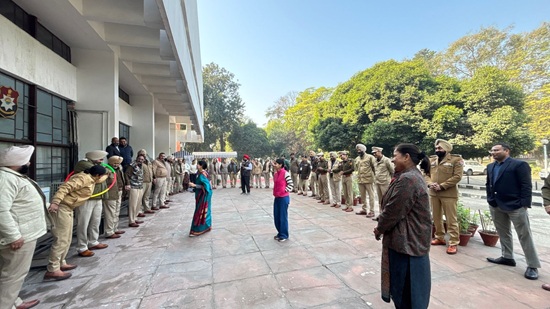
Punjab Police launches ‘Mainstreaming of Women Police’ project, training 2,000 officers across 288 stations to improve gender sensitivity and empowerment.
The “Mainstreaming of Women Police” project, a historic endeavor by the Punjab Police, aims to thoroughly evaluate and improve the role and integration of women police officers throughout the state. The project started with a three-day Training of Trainers (ToT) workshop that took place from December 2–4, 2025, at the Punjab Police Academy (PPA), Phillaur.
The Hartek Foundation partnered with Punjab Police’s Community Affairs Division (CAD) Wing to organize the ToT. There were about 60 master trainers trained at the session, including four senior police officers from each of Punjab’s 13 districts. It will now be the duty of these officers to spread the instruction throughout their districts.
Shaping the Police Persona, Gender Sensitization, the Role of Police in Delivering Justice to Underserved Sections, and Strategies for Mainstreaming Women Officers within the traditionally male-dominated police force were among the important courses covered in the training program. The duties of senior officers in promoting the professional growth of women in law enforcement were given particular attention.
Speaking about the importance of the project, Special DGP Community Affairs Division (CAD) Gurpreet Kaur Deo stated that this ambitious project is being carried out as part of the Project “Mainstreaming of Women Police,” which aims to provide an evidence-based evaluation of the success of the Government of India’s nationwide roll-out of the women’s helpdesk project, in which two women officials have been assigned to each of Punjab’s 384 police stations.
Also read : Punjab Police Arrest 66 Drug Smugglers in 257 Raids Under CM Mann’s ‘Yudh Nashian Virudh’ Drive
Punjab Police and J-PAL (Abdul Latif Jameel Poverty Action Lab), a well-known non-governmental organization that specializes in policy analysis through Randomized Controlled Trials (RCTs), have signed a Memorandum of Understanding (MoU) to guarantee a scientific evaluation of the training’s impact.
Approximately 100 to 120 Master trainers trained by CAD Wing in partnership with PPA, Phillaur, and an NGO called Hartek Foundation will conduct trainings in each of the 288 police stations in the state as part of this project. The trainings will focus on the role of women in society and the marginalization of women police due to gender stereotypes and the policing subculture, which is focused on core policing areas like maintaining law and order, preventing and detecting crime, tracking and dealing with gangsters and drug dealers, fighting terrorism, and so on. In contrast, less attention is given to equally important emerging areas of police intervention, such as cybercrime, crime against women, children, and the elderly, traffic issues, police response and behavior, and police image.
The control police stations will be the about 96 police stations in the state that do not receive any training. A second round of advanced training will be provided to the 120 Master Trainers who were chosen for this project in February 2026. Following this, the Master Trainers will train a subset of police officials in their districts’ Police Stations over the course of three rounds, from March 2026 to June 2026.
Also read : Punjab Launches ‘Empowering Lives Behind Bars’ Program to Transform 24 Jails Into Skill Hubs
According to the Special DGP, J-Pal will conduct a baseline survey of police respondents in each of the 288 police stations to find out how they feel about women in the police and gender sensitivity before training in the stations begins. She noted that in order to make final conclusions about the shift in gender attitudes and the roles of women in law enforcement, J-PAL will survey both residents and police officers who participated in the baseline survey at the conclusion of the district trainings.
On the other hand, PPA Phillaur has planned a second ToT session for master trainers from the remaining 15 districts for December 22–24, 2025. By personally training more than 2000 police officers, the project hopes to increase institutional capacity and create a more effective and inclusive policing environment in Punjab.