
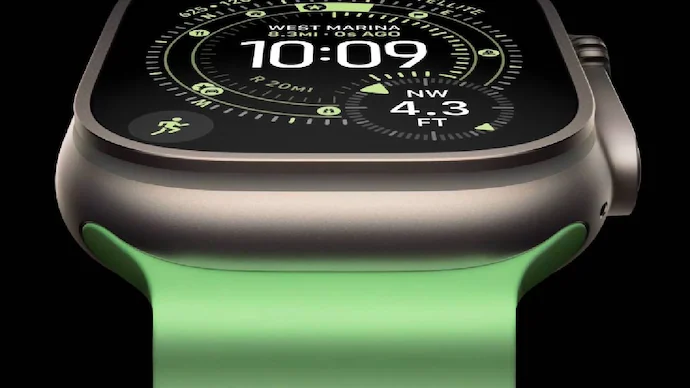
Apple now uses 100% recycled titanium in 3D-printed Apple Watch Ultra 3 and Series 11 cases, reducing material waste and advancing sustainability.
Apple Watch : Initially, Apple faced a task that most businesses would have deemed unattainable. The team questioned if recycled titanium might be used to reengineer a process known for producing rough prototypes in order to create millions of identical watch enclosures. That one query served as the impetus for years of testing, improvement, and measurement.
According to Kate Bergeron, Apple’s vice president of product design, “it wasn’t just an idea—it was an idea that wanted to become a reality.” We started testing it as soon as we posed the question. We had to demonstrate that our technology could satisfy the high standards of quality we require through constant prototyping, process optimization, and massive data collection.
Eventually, this investigation resulted in a significant change. 100% recyclable aerospace-grade titanium powder is now used in the 3D-printed casings of the Apple Watch Ultra 3 and the titanium Apple Watch Series 11. Without sacrificing sustainability or material quality, Apple’s teams had to make sure that Ultra 3 maintained its strength and portability and Series 11 maintained its mirror finish.
“Environment is a core value for every team at Apple,” says Sarah Chandler, vice president of Environment and Supply Chain Innovation. “We were aware of the enormous potential for material efficiency that 3D printing held, which is essential to achieving Apple 2030.”
A Revolution in Manufacturing Constructed Layer by Layer
The overarching goal of Apple 2030 is to make the corporation carbon neutral in its operations, production, and product lines. Renewable energy is already used in the creation of every Apple Watch. By switching from subtractive machining to additive fabrication, Apple is able to construct cases that are almost identical to their final design, significantly cutting down on waste.
“Getting two watches out of the same amount of material used for one is a huge accomplishment,” Chandler says of a 50% drop. The adjustment is expected to save Apple around 400 metric tonnes of titanium this year.
Also read : Winter Laundry Tips: Keep Your Clothes Dry Without Stepping Outside
“This technology has been evolving for a while, and its prototypes have become more accurate representations of our designs,” says Dr. J Manjunathaiah, senior director of Manufacturing Design at Apple Watch and Vision. “Our goal has always been to manufacture our products with minimal material. We couldn’t use 3D printing to produce cosmetic items on a large scale before. Thus, we began experimenting with creating cosmetic elements using 3D printing metal.
How Apple Overcame Powdered Titanium
Extreme precision was necessary due to the science underlying the process. More than 900 layers are constructed by printers, but before printing could start, the material itself needed to be redesigned. Bergeron recalls, “This was state-of-the-art materials science.” “The powder had to have a diameter of 50 microns, which is comparable to extremely fine sand,” Manjunathaiah says.
“If it has oxygen or not, it reacts differently when you strike it with a laser. So we needed to figure out how to maintain a low oxygen concentration. “It requires very fine squeegeeing of this powder to dial in that thickness so that each layer is precisely 60 microns,” Bergeron continues. Making this scalable requires us to go as quickly as we can, but at the same time, we must move as slowly as we can. This made it possible for us to be effective while still achieving the design objectives.
Following printing, the cases undergo structural verification, dimensional checks, and powder cleanup. Bergeron asserts, “The mechanical engineers must be the world’s best at solving puzzles.”
Innovative Potential in All of Apple’s Hardware
Additionally, 3D printing enabled Apple to improve bonding for cellular antenna housings by creating inside textures that were impossible to achieve with forging. The business used small-scale testing to fine-tune every variable over the course of years as it worked toward this point. In order to move on to the next phase, Bergeron explains, “we always try to take those incremental steps.” Apple expanded the innovation beyond watches after the procedure was ultimately validated. Using the same recycled titanium powder, the USB-C port enclosure for the new iPhone Air is 3D printed.
Chandler states, “We’re incredibly committed to systems change.” “We never take action just once; rather, we take action to make it the norm for the system as a whole.”
Apple’s transition to 3D printing is not only about materials. It is evidence of the ways in which design, sustainability, and modern manufacturing are starting to come together to influence the company’s hardware in the years to come.