
Army prepares new frontline units amid Pakistan-China threats
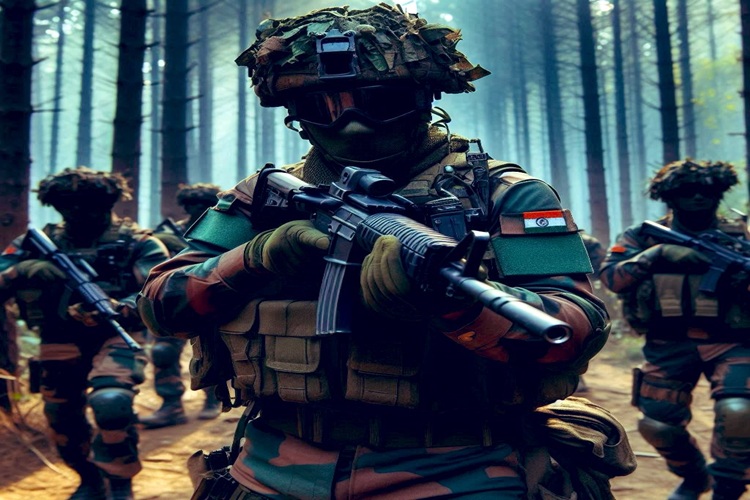
The Indian Army is stepping up preparations to handle a potential two-front challenge from Pakistan and China. In a major move, five newly raised Bhairav Commando battalions will be ready for frontline deployment by the end of this month, according to sources in the defence and security establishment.
The Bhairav Commandos, conceived as a lighter but highly agile force, are expected to strengthen India’s forward posture along the northern, northeastern, and western borders. Officials confirmed that three battalions will be deployed on the northern frontier facing Pakistan and China, one in the northeast, and one along the western front.
Bhairav Commandos: Role and training
The Bhairav units are designed to complement India’s Special Forces by handling cross-border interdiction, reconnaissance, and disruption of enemy positions. This division of roles allows Special Forces to focus on more complex, high-value missions.
Each Bhairav battalion consists of around 250 soldiers who undergo a two-phase training program. They first receive basic preparation at their parent unit’s training centre, followed by advanced exercises conducted alongside Special Forces. Although not as heavily armed as elite units, their presence is expected to significantly expand India’s operational flexibility.
Defence sources indicated that 23 Bhairav battalions will be raised by October, making the force a central element of the Army’s restructuring plan. The decision follows heightened hostilities in May, during which China was reported to have supported Pakistan’s Operation Sindoor by sharing real-time intelligence on Indian troop movements.
Modernising artillery for drone warfare
Parallel to the induction of Bhairav units, the Army is accelerating artillery modernisation to counter new-age threats such as drones, loitering munitions, and precision ISR (Intelligence, Surveillance, Reconnaissance) platforms.
The Army will introduce Shaktibaan regiments this month. These specialised formations will rely heavily on unmanned aerial systems. Each regiment will field three batteries: two equipped with long- and medium-range loitering munitions, and a third armed with swarm drones and remotely piloted aircraft systems (RPAS).
Notably, the Shaktibaan units are being created under a “Save and Raise” model, repurposing existing assets instead of building entirely new ones.
In addition, conventional artillery regiments will incorporate Divyastra Batteries, enabling “sensor-to-shooter” missions. Under this configuration, two batteries will operate medium artillery guns, while the third will deploy loitering munitions and dual-role RPAS. This structure allows real-time engagement of enemy positions without relying on external intelligence feeds.
Rudra Brigades: Integrated fighting formations
The Army’s restructuring also includes the creation of Rudra Brigades, which combine multiple arms under a single command. These all-arms brigades will integrate infantry, mechanised forces, artillery, engineers, UAVs, and Special Forces.
Two Rudra brigades are already being converted and are expected to deploy along the China and Pakistan borders soon. Unlike the Integrated Battle Groups (IBGs) proposed earlier, Rudra brigades will retain the rank of Brigadier as their commanding officer. Sources explained that IBGs were conceptualised as scaled-down divisions, while Rudra brigades are slightly larger than standard formations, designed for rapid, integrated operations.
Strategic significance of restructuring
The Army’s current transformation drive, announced by Chief of Army Staff General Upendra Dwivedi, reflects lessons learned from recent conflicts. The surge in drone warfare, cross-border proxy operations, and real-time intelligence sharing between adversaries has prompted India to adopt a more flexible and technology-driven posture.
Military analysts believe that Bhairav units, coupled with drone-enabled artillery and integrated Rudra brigades, represent a decisive shift in India’s warfighting doctrine. By blending agility, precision, and multi-domain integration, the Army aims to maintain an edge across both western and northern frontiers.
With tensions simmering along the Line of Actual Control (LAC) and persistent hostilities along the Line of Control (LoC), the new formations are expected to play a critical role in India’s deterrence strategy.