
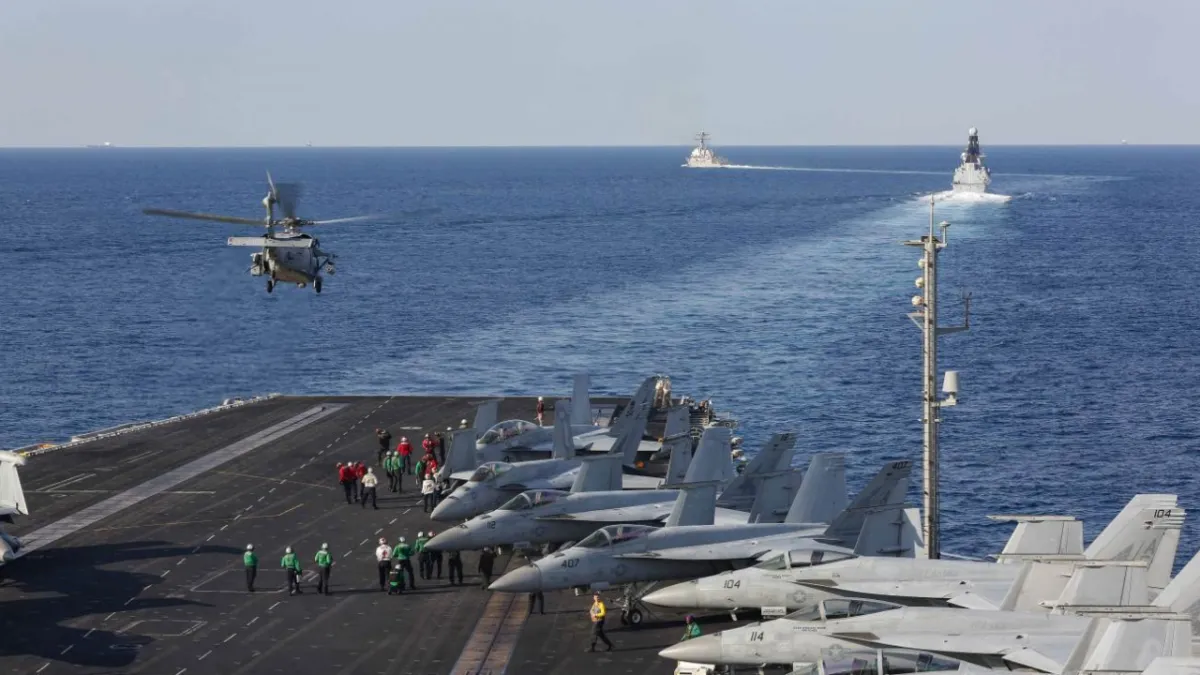
The United States has rapidly increased its military presence in the Middle East, deploying over 50 fighter jets within 24 hours, even as diplomatic negotiations with Iran over its nuclear program continue in Geneva. According to Axios, a U.S. official confirmed the accelerated aircraft movement, while aviation analysts independently tracked the arrival of multiple advanced jets, including F-22s, F-35s, and F-16s, accompanied by aerial refueling tankers, indicating readiness for extended operations.
Second Carrier Strike Group En Route
In addition to the air buildup, the USS Gerald R. Ford carrier strike group has left the Caribbean and is crossing the Atlantic toward the Middle East, a Navy official told the Associated Press on condition of anonymity. The carrier is accompanied by three guided-missile destroyers — the USS Mahan, USS Bainbridge, and USS Winston Churchill — and is expected to reach waters near Iran in about a week. The USS Abraham Lincoln and other American forces were already deployed in the region earlier this year, reflecting a sustained military presence.
Khamenei Issues Stern Warning
Amid the U.S. deployments, Iran’s Supreme Leader Ayatollah Ali Khamenei issued a strong warning to President Donald Trump, cautioning that even the world’s strongest military could be severely hit. Speaking in Tehran, he stressed that while warships are powerful, Iran possesses weapons capable of neutralizing them. Khamenei also reiterated that decades of U.S. pressure have failed to dismantle the Islamic Republic and would not succeed.
Also read : Sanae Takaichi Reappointed as Japan’s Prime Minister, Prepares Second Cabinet After Sweeping Election Win
Strait of Hormuz Drills Escalate Tensions
Tensions further heightened as Iran temporarily closed the Strait of Hormuz for live-fire military exercises. State media reported missile launches as part of drills justified for “safety and maritime concerns.” The strait is a vital route for global energy, with roughly one-fifth of the world’s oil passing through it. Publicly declaring its closure represents a notable escalation amid the current standoff.
Despite the visible military movements, both sides indicated cautious optimism after the Geneva talks. U.S. officials acknowledged that progress was made, although key differences remain unresolved.