
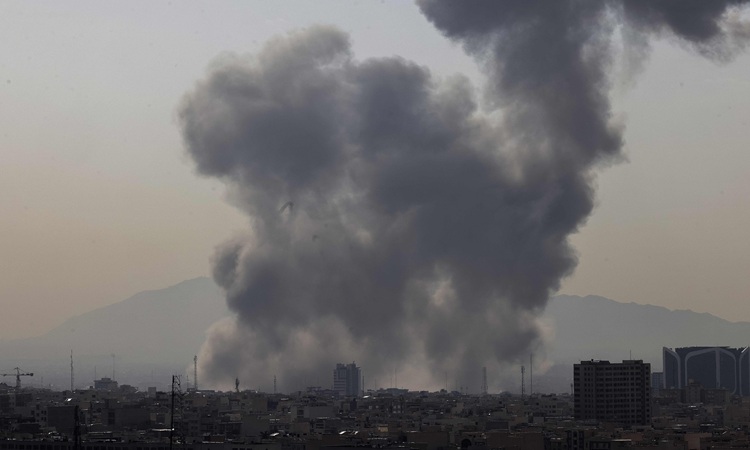
President Trump announces “major combat operations” as explosions rock the Iranian capital and regional tensions explode
TEHRAN/WASHINGTON — The Middle East has entered a period of unprecedented conflict. On Saturday, February 28, 2026, the United States and Israel launched a massive joint military offensive against the Islamic Republic of Iran.
President Donald Trump confirmed the start of Operation Epic Fury in a televised address. He described the campaign as “massive and ongoing.” Furthermore, he stated that the primary objective is to eliminate “imminent threats” from the Iranian regime.
Initial reports indicate that strikes targeted several major cities. These include Tehran, Isfahan, Qom, and Tabriz. In the capital, explosions occurred near University Street and the Jomhouri area. Notably, some strikes reportedly hit close to the compound of Supreme Leader Ayatollah Ali Khamenei.
Trump Calls for Regime Change Amid Rising Smoke
During his eight-minute address, President Trump made an extraordinary appeal. He urged the Iranian people to “take over your government” once military operations conclude. This statement signals a definitive shift toward active regime change in Iran.
The President warned that “the hour of your freedom is at hand.” However, he also acknowledged the grave risks involved. He cautioned the American public that “courageous American heroes” might lose their lives in this mission.
The Pentagon has deployed a massive naval armada to the region. This includes the aircraft carriers USS Gerald R. Ford and USS Abraham Lincoln. Consequently, this represents the most significant U.S. military buildup in the Middle East since the Iraq War.
Iran Retaliates with Operation True Promise 4
Tehran has not remained silent following the initial bombardment. The Islamic Revolutionary Guard Corps (IRGC) launched a counter-offensive dubbed “Operation True Promise 4.” This involved a “first wave” of ballistic missiles and drones.
The retaliatory strikes targeted several U.S. military installations across the Persian Gulf. Reports indicate impacts at Al Udeid Air Base in Qatar and Al Salem Air Base in Kuwait. Additionally, the U.S. Fifth Fleet headquarters in Bahrain reported nearby explosions.
Meanwhile, sirens sounded throughout northern Israel as defensive systems engaged incoming threats. Authorities in Jordan also reported intercepting missiles over their airspace. One person in Abu Dhabi was reportedly killed by falling debris during the exchange.
Nuclear Ambitions and Failed Diplomacy
The justification for this escalation stems from Iran’s nuclear and missile programs. Trump accused Tehran of rebuilding facilities that he previously claimed were destroyed in 2025. He insisted that the regime refused to renounce its nuclear weapons pursuit.
Oman’s Foreign Ministry recently claimed a diplomatic “breakthrough” was close. However, Washington appears to have lost patience with the pace of negotiations. Trump asserted that Iran was merely using talks to buy time for its “malicious pursuit.”
Moreover, the global economic impact was immediate. Oil prices surged as regional states, including Iraq and the UAE, closed their airspace. Major airlines have suspended all flights across the Middle East.
What Happens Next?
Military analysts suggest this is only the “initial phase” of a multi-day operation. The U.S. has promised to “annihilate” the Iranian navy and raze its missile industry. Meanwhile, the world watches to see if this escalates into a full-scale regional war.
For now, the situation remains fluid. Citizens across the region have been urged to shelter in place. As bombs continue to drop, the map of the Middle East may be changed forever.
Also Read : Trump Calls for Regime Change in Iran Amid Massive Military Strikes