
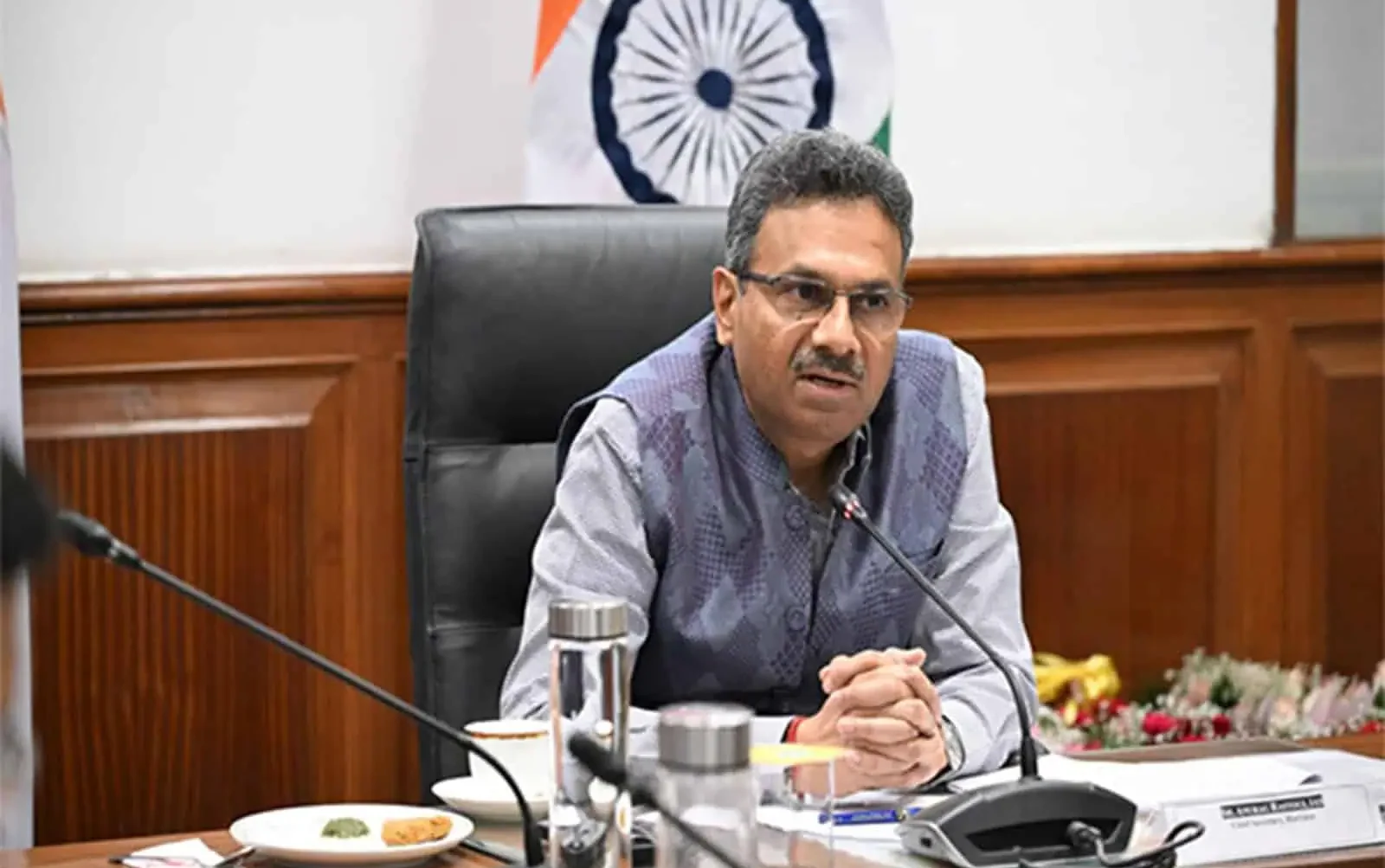
Chandigarh, Haryana: In a significant move towards sustainable agriculture and scientific water management, the State Level Sanctioning Committee (SLSC), chaired by Haryana Chief Secretary Sh. Anurag Rastogi, has approved four Community-Based Solar-Powered Integrated Micro Irrigation Projects under the Micro Irrigation & Command Area Development Authority (MICADA), Haryana.
With a total investment of ₹402.41 crore, the projects will cover 61 canal outlets across 20 blocks in Bhiwani, Jhajjar, Kurukshetra, and Mahendragarh districts. Scheduled for completion between 2026-27 and 2028-29, the initiative aims to bring 11,040 hectares of culturable command area under advanced micro-irrigation systems, benefiting 8,926 farmers across 94 villages.
District-Wise Allocation and Economic Viability
The allocation of funds across districts includes ₹95.78 crore for Bhiwani, ₹114.68 crore for Jhajjar, ₹77.17 crore for Kurukshetra, and ₹114.78 crore for Mahendragarh. The benefit-cost ratio ranges from 1.21:1 to 1.65:1, reflecting strong economic viability and long-term returns for farmers. By promoting drip and sprinkler irrigation systems, the projects are expected to enhance water-use efficiency, reduce transmission losses, and improve crop productivity.
Focus on Climate-Resilient and Sustainable Practices
Chairing the meeting, Chief Secretary Sh. Anurag Rastogi emphasized that integrated supply and demand management of water is crucial to tackle climate variability and declining groundwater levels. He directed all departments to ensure timely execution, strict monitoring, and effective coordination to deliver benefits to farmers within the set timeframe. The adoption of solar-powered irrigation systems is expected to reduce operational costs and promote environmentally sustainable farming. Officers were also instructed to engage directly with farmers and share best practices in the field.
Also read : CM Nayab Saini Inaugurates and Lays Foundation Stones for ₹103 Crore Development in Uchana
Strengthening Transparency and Farmer Protection
The Committee also approved 16 reform agendas under the Per Drop More Crop (PDMC) Guidelines 2025, focusing on registration of manufacturers and suppliers to ensure transparency, accountability, and farmer protection. Out of 165 applications, 147 manufacturers and suppliers were found eligible for registration for 2025–26 to 2029–30. Vendors have agreed to align their rates with approved state/PDMC norms, preventing inflated pricing.
The scheme will continue under a beneficiary-driven Direct Benefit Transfer (DBT)/in-kind model, allowing farmers to choose suppliers while ensuring subsidies are released within approved cost ceilings. Integration of the MICADA portal with the GST system will facilitate digital verification of invoices, preventing fake billing. A component-wise bank guarantee has also been introduced to ensure financial accountability, and GST has been included as part of the admissible subsidy.
Quality Assurance and Implementation Strategy
To ensure high standards, the State has strengthened quality assurance mechanisms through laboratory report scrutiny, strict penalties for violations, and independent monitoring of at least 20% of projects annually. A cluster-based implementation approach and a pilot Public-Private-CSR model were discussed to expand coverage and ensure long-term maintenance, particularly for SC, small, and marginal farmers.
Building on Past Success
Between 2022-23 and 2024-25, MICADA successfully implemented 99 NABARD-funded Micro Irrigation Fund schemes across 18 districts, with a total investment of ₹563.43 crore, achieving nearly 40% coverage of targeted areas. The newly approved projects build on this foundation, reaffirming Haryana’s commitment to technology-driven, climate-resilient, and farmer-centric agricultural development.
Senior officials present at the meeting included Principal Secretary to CM Sh. Arun Kumar Gupta, Additional Chief Secretary (Irrigation & Water Resources) Sh. Anurag Agarwal, Principal Secretary Agriculture & Farmers’ Welfare Sh. Pankaj Agarwal, Director General Agriculture Sh. Rajnarayan Kaushik, MICADA Administrator Sh. Birender Singh, Chief Engineer MICADA Sh. S.D. Sharma, and Director-MI MICADA Sh. Dhoop Singh, among others.