
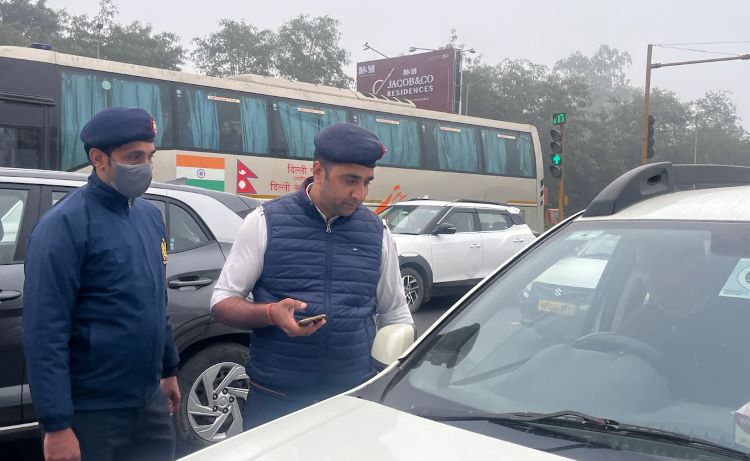
Delhi-Noida border saw strict vehicle checks as AQI touched 490. Non-BS6 vehicles were turned back or fined ₹20,000 under GRAP Stage IV.
New Delhi: On this misty Thursday morning, a heavy layer of deadly haze covered the Delhi-Noida border at the DND Flyway. At the adjoining Chilla border, the air quality fell into the “hazardous” category, with an AQI of about 490. As part of Stage IV of the Graded Response Action Plan (GRAP), Delhi Police and transport enforcement teams increased their inspections of arriving cars, significantly reducing visibility.
“We are rigorously inspecting non-BS6 commercial and private vehicles registered outside of Delhi,” stated Deepak, the officer in charge of operations for the Delhi transport department. Violators must either do a U-turn or face a Rs 20,000 challan. Additionally, drivers without current Pollution Under Control Certificates (PUCC) are subject to fines.
In order to slow down traffic and conduct checks, Delhi Police have set up obstacles.
“We’re stopping cars that seem old and don’t have blue stickers on the car showing BS 6 vehicles,” a UP Traffic Police officer on the ground continued. Additionally, we have been instructed to fine gasoline-powered vehicles that are 15 years old and diesel vehicles that are 10 years old and meet BS-III emission criteria (or less).
Rakesh, a resident of Faridabad, halted his BS3 Hyundai Creta and said, “We have to pay fines for pollution, which the central government cannot control.” I was unaware of this rule because I live in Faridabad. Although we pay road taxes, why do traffic cops randomly inspect cars? What about government buses? They are not having their emissions examined.
Vehicle registration numbers are entered into portable computers for monitoring in order to rapidly confirm PUCC validity and BS criteria.
In the winter, transportation accounts for more than 20% of PM2.5, with light motor vehicles and two-wheelers accounting for 93% of Delhi-NCR’s 2.88 crore vehicles. Up to 31 times more particulate matter and 16 times more nitrogen dioxide are released by about 37% of those who are BS-Ill or older.
Also read : Delhi Pollution: Supreme Court Orders Toll Plaza Suspension to Curb Toxic Air
“People should know about vehicular pollution by now,” said Deepak, a Delhi transport officer. We have troops stationed at checkpoints, including Delhi Traffic Police and transport teams, so if owners try other ways, they are unable to flee. This can aid in the fight against vehicle pollution if there is governmental will and public awareness.
Delhi prohibited non-BS VI cars registered outside the capital following days of “severe” air quality. In the NCR, automobile emissions account for more than 20–40% of winter PM2.5, with older cars producing significantly more pollutants.
Experts emphasize more comprehensive measures. About 40% of Delhi’s PM2.5 is caused by vehicles, and the PUC system is ineffective in measuring particle matter. To reduce transboundary pollution, bans must be accompanied by scrappage programs and improved public transportation.
Anil Chhikara, a former Transport Commissioner, stated: “A dedicated pollution task force and practical tailpipe emission enforcement are urgently needed.” Despite BJP governments being in control, the Delhi government’s hasty, unprofessional approach to action is still unsustainable, made worse by hackers providing phony PUCC certificates and a conspicuous lack of interstate cooperation.”