
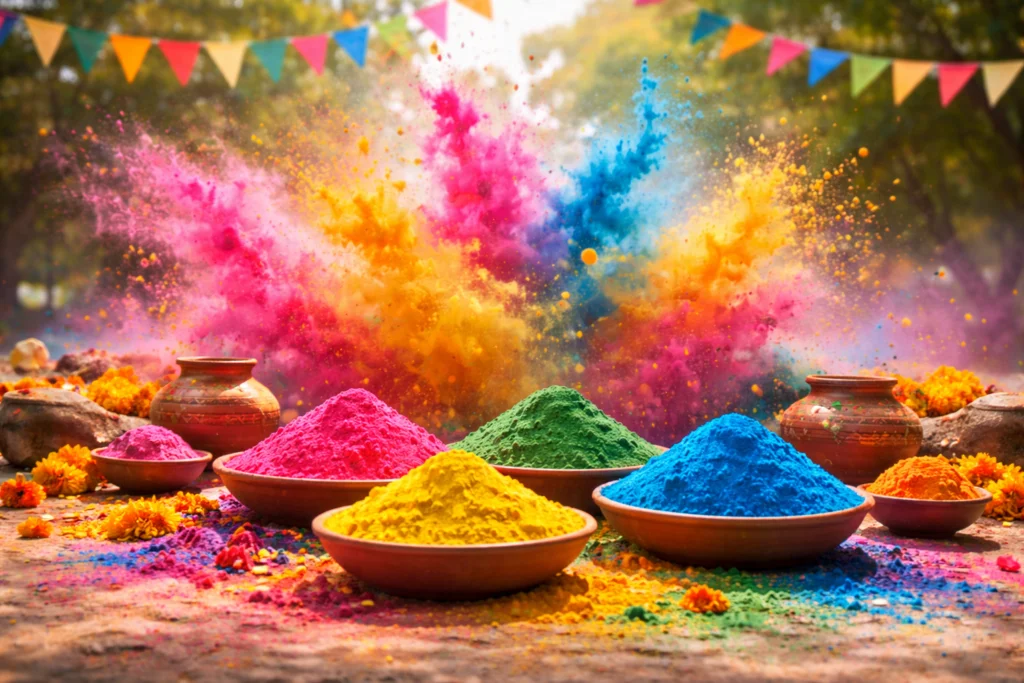
India’s vibrant festival of colours, Holi, is set to witness a unique celestial event in 2026, intriguing devotees and astrology enthusiasts alike. The holiday will see an unusual 24-hour gap between Holika Dahan and Dhulendi, raising questions about its astrological significance and the rare astronomical alignment behind it.
Holika Dahan 2026 Dates and Timing
Traditionally, Holika Dahan is observed on the night of the full moon (Purnima), followed by Dhulendi—the playing of colours—the next morning. However, planetary positions in 2026 have disrupted this sequence.
- Holika Dahan: Late night of March 2, 2026, continuing into the early hours of March 3.
- Pause Day: March 3 will remain a day of abstinence due to Sutak and a total lunar eclipse.
- Dhulendi (Colour Festival): Celebrated on March 4, 2026.
According to Hindu scriptures, certain rituals like Holika Dahan should not be performed during Bhadra Kaal, considered an inauspicious period. On March 2, the Purnima Tithi begins at 5:55 PM, coinciding with the start of Bhadra Kaal. Holika Dahan will therefore be performed only after Bhadra’s “Puccha” (tail) period ends at 12:50 AM on March 3, making 12:50 AM to 2:02 AM the most auspicious time.
March 3: The ‘Blood Moon’ Lunar Eclipse
Holi 2026 is notable for a total lunar eclipse visible across India. Unlike the eclipses during Holi in 2024 and 2025, which were not visible in India, this eclipse will occur from 3:19 PM to 6:47 PM on March 3.
During Sutak and the eclipse, loud celebrations and playing with colours are traditionally avoided. Instead, devotees are advised to engage in spiritual practices. This makes March 3 a day of purification and reflection rather than festivities.
Also read : 8 Essential Intimate Care Tips Every Young Girl Should Follow
Astronomically, the eclipse will produce a striking “Blood Moon”, when the Moon passes through the Earth’s shadow (Umbra) and appears copper-red. The timing of this rare celestial event, immediately after Holika Dahan, gives Holi 2026 both spiritual and scientific significance.
Holi Celebrations on March 4
Once the eclipse ends, purification rituals will be performed, and Holi will be celebrated on Wednesday, March 4. In astrology, Wednesday is ruled by Mercury (Budh), associated with intellect, speech, and happiness. Celebrating Holi after the eclipse is believed to bring emotional relief, joy, and harmony in relationships.
Guidelines During and After the Eclipse
- During Sutak on March 3, avoid touching idols and place Tulsi leaves in food to maintain purity.
- Chant mantras such as “Om Namah Shivaya” or the Mahamrityunjaya Mantra during the eclipse.
- On March 4, before playing Holi, sprinkle Gangajal, take a ritual bath, and apply gulal to deities before starting the celebrations.
Holi 2026 is thus a once-in-a-century-like celestial event, combining ancient rituals with a rare astronomical phenomenon, making this festival especially meaningful for devotees and astrology enthusiasts.