
Poland supports India as US threatens 500% tariffs over Russian oil. Jaishankar engages European leaders to strengthen global ties.
Poland has expressed support for India amid a deepening conflict with the US over its ongoing purchases of Russian crude oil, even as Washington escalated its tariff threats against New Delhi, including the possibility of slapping punitive levies of up to 500%.
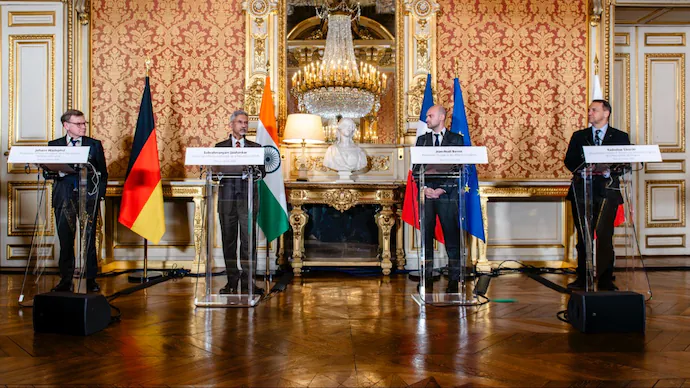
Speaking in Paris following India’s first meeting with the Weimar Triangle organization on Wednesday, Polish Foreign Minister Radosaw Sikorski expressed satisfaction that India had begun to reduce its reliance on Russian oil supplies.
“I expressed my satisfaction that India has reduced Russian oil imports because they are fueling Putin’s war machine,” Sikorski said, flanked by External Affairs Minister S Jaishankar and other European leaders.
Also read: PM Modi Holds Telephonic Talk with Israeli PM Netanyahu, Strengthens Strategic Partnership
Sikorsi’s remarks come against the backdrop of increasingly strained relations between New Delhi and Washington. US President Donald Trump had previously placed 50% tariffs on Indian imports, but has also approved a bipartisan bill that would empower the US to levy duties of up to 500% on countries who “knowingly purchase” Russian oil or uranium.
Republican Senator Lindsey Graham stated that the US President approved the proposal following a “productive” conversation, with a vote possibly as early as next week.
Trump had already imposed a 25% reciprocal tax on Indian commodities, along with an additional 25% penalty connected to India’s Russian oil purchases, bringing total tariffs on some products to 50%. In recent statements, Trump hinted at more action, saying Prime Minister Narendra Modi “knew I was not happy,” and warned that tariffs might be raised “very quickly.”
Jaishankar’s visit to Europe is significant.
Against this sensitive backdrop, Jaishankar, who is in Europe, emphasized the significance of India’s deeper engagement with its leaders.
“What kind of world do we want to live in?” What would be the norms and other connected issues?” he said, emphasizing Europe’s importance in global affairs and the need to deepen India’s ties with the continent. “I believe we can bring more stability to the international economy and global politics. And that is exactly why I am here,” he remarked.
Jaishankar took part in India’s maiden engagement in the Weimar Triangle framework, meeting with French Foreign Minister Jean-Noel Barrot, German delegates, and Poland’s Sikorski.
Also read: PM Modi Hails Commissioning of ICGS Samudra Pratap, Boosts India’s Maritime Security
The Weimar Triangle is a regional political organization founded in 1991 by France, Germany, and Poland to promote European integration, political discourse, security cooperation (especially with Russia and Ukraine), and economic and cultural relations. It is named after the German city where the trio first met.
Aishankar described the conversations as brief but open, addressing India-EU relations, the Indo-Pacific, and the conflict in Ukraine. He stated that ties with the European Union and its member states represented India’s “greatest unrealised potential.”
In the coming weeks, India will receive German Chancellor Friedrich Merz, French President Emmanuel Macron, and senior EU leaders, highlighting New Delhi’s efforts to balance global ties amidst increased uncertainty and pressure from Washington.
India recalibrates its energy strategy.
The diplomatic push comes as India reassesses its energy strategy. According to the Centre for Monitoring Indian Economy, India’s monthly imports of Russian oil would stay high through 2025, with Russia accounting for 27 percent to roughly 39 percent till November.
Imports reached at 7.7 million tonnes in November, accounting for 34% of India’s crude consumption. However, Russia’s share has now dropped below 25% and may fall more this month.
According to data from the Centre for Research on Energy and Clean Air, India’s daily imports of Russian oil from non-sanctioned firms fell to around 72.9 million euros in early January, down from 130.5 million euros in late November and a peak of 189 million in July 2023.
Following fresh US sanctions, several refiners, including Reliance Industries, HPCL, and MRPL, have suspended Russian oil imports, while others continue to buy from non-sanctioned suppliers.
Nonetheless, India is one of Russia’s largest oil consumers, having imported an estimated 144 billion euros in crude since the Ukraine conflict began in 2022, underlining the delicate balance New Delhi is attempting to strike amid global economic and geopolitical turmoil.