
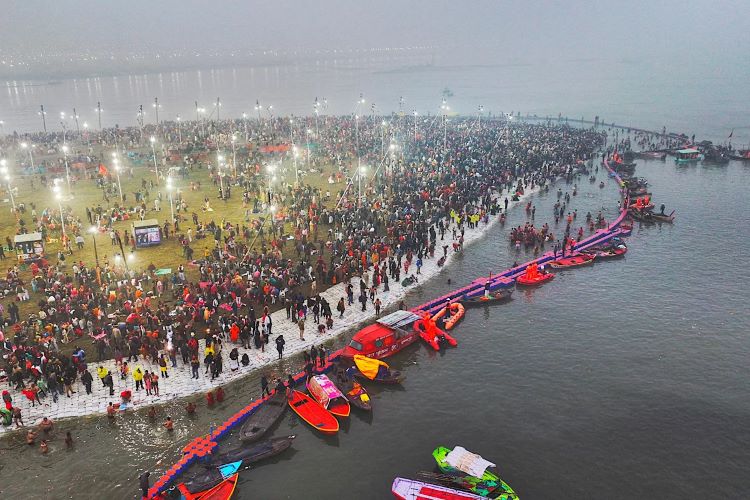
Millions of devotees gather at Prayagraj Sangam for Paush Purnima, starting Magh Mela with sacred bathing and Kalpvas rituals.
Thousands of devotees braved the winter cold to take the first significant holy dip of the season as dawn broke on Paush Purnima, transforming the Sangam into a great ocean of faith. In the early hours of Brahma Muhurta, pilgrims began to arrive in steady streams, motivated by long-standing tradition and profound spiritual belief. This marked the beginning of the sacred bathing ritual. By the end of the day, authorities predict that between 25 and 30 lakh devotees will submerge themselves in Prayagraj’s river confluence.
The Paush Purnima this year is particularly important. It coincided with an unusual celestial event being seen at the Magh Mela after a 75-year break when the full moon emerged at 4 a.m. Millions of devotees began a month-long period of austerity, prayer, and disciplined living with this auspicious event, which also marked the official start of the Kalpvas rite.
Purnima Shakambhari
Many regions of India celebrate Shakambhari Purnima, which is devoted to the goddess Shakambhari. It is observed in the month of Pausha, which in the Gregorian calendar usually corresponds to January.
In addition, the event marks the end of the eight-day Shakambhari Navaratri celebration.
Kalpvas’s Sacred Beginning
Across the expansive fairgrounds, Kalpvasis, who follow a month of spiritual abstinence, have started to settle. Authorities anticipate that between 20 and 25 lakh Kalpavasis will live here, spending their days in penance, meditation, and religious observance. An incredible 12 to 15 crore pilgrims from all over the country are expected to attend the Magh Mela over the course of the next 1.5 months, particularly on important bathing dates.
Also read: PM Modi Pays Tribute to Rani Velu Nachiyar on Her Birth Anniversary
A Sadhu considered the event’s spiritual significance and remarked, “This sacred gathering offers devotees a chance for purification, spiritual elevation, and divine blessings.” Taking a bath on these holy days is thought to offer grace and remit sins.
Pilgrims Applaud Plans in the Face of a Huge Crowd
Many attendees expressed satisfaction with the amenities despite the large turnout. “The turnout is huge, but the arrangements are excellent,” said one pilgrim. Facilities and security have been effectively controlled.
Numerous government agencies have organized extensive preparations to support the inflow. While temporary infrastructure, such as roads, power supplies, drinking water, and sanitation, has been quickly built to meet daily demands, a consistent flow of 10,000 cusecs of water is being maintained.
High Alert for Logistics, Security, and Healthcare
With hospitals, health centers, ambulances, and traditional medicine clinics positioned across the arena, healthcare services have been reinforced. With the help of thousands of employees and state-of-the-art waste-management technologies, sanitation teams are working around the clock. The 800-hectare fair is spread across seven sectors and is backed by plenty of parking, transportation, and a robust security system that includes police, fire, water barricading, and AI-enabled security cameras.
Major bathing days like Makar Sankranti on January 15, Mauni Amavasya on January 18, Basant Panchami on January 30, Maghi Purnima on February 1, and Mahashivratri on February 15 are all scheduled to attract large crowds as part of the Magh Mela calendar.