
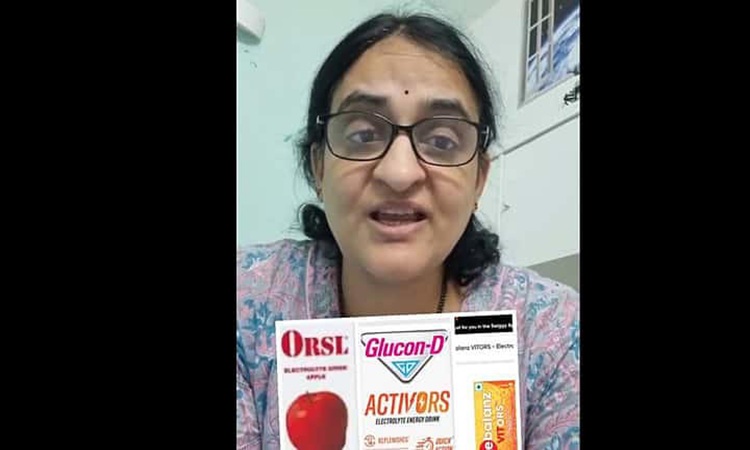
Hyderabad Doctor Questions FSSAI’s Stand in ORSL Row following Delhi High court stay
Hyderabad: A heated debate has erupted between a city-based paediatrician and India’s top food regulator, the Food Safety and Standards Authority of India (FSSAI), over the sale of high-sugar ORSL drinks.
On Friday, Dr. Sivaranjini Santosh, a paediatrician known for her public health advocacy, accused the FSSAI of “allowing” the sale of non-compliant Oral Rehydration Solution (ORS) products despite a recent ban. Taking to social media, she tagged Prime Minister Narendra Modi and BJP president JP Nadda, calling the regulator’s stance “unfair” and “a setback to public health protection.”
Dr. Sivaranjini’s criticism follows a court stay order reportedly issued on October 17, which she claims may permit the sale of existing ORSL stocks manufactured by JNTL, the Indian subsidiary of Kenvue—a spin-off from Johnson & Johnson.
She expressed disappointment that FSSAI agreed to a settlement with the company, which she believes undermines the regulator’s October 15 directive banning misleading “ORS-labelled” products.
FSSAI’s Ban on Misleading “ORS” Products
The controversy began after the FSSAI issued a landmark order on October 15, prohibiting any food or beverage product from using the term “ORS” unless its formulation meets World Health Organisation (WHO) standards for Oral Rehydration Salts.
According to the directive, only solutions with WHO-recommended levels of glucose, sodium, and potassium can be marketed as “ORS.” Drinks such as ORSL, Rebalanz VitORS, and ORSfit—which are high in sugar but low in essential electrolytes—fall outside this definition.
The order was a major win for Dr. Sivaranjini, who has been leading an eight-year campaign against what she describes as “misleading and harmful” beverages. Health experts have also warned that such drinks can worsen dehydration in children suffering from diarrhoea due to their high sugar content and incorrect electrolyte balance.
However, just two days later, a stay order was issued by a Delhi court based on an agreement between FSSAI and JNTL. The decision temporarily halted the enforcement of the October 15 order pending review of JNTL’s representation.
Doctor’s Appeal to PM Modi and Health Ministry
In her post on X (formerly Twitter), Dr. Sivaranjini wrote,
“My fight has always been against misleading labels like ORSL, RebalanzVitORS, ORSfit, and GluconDActivORS. The 17th October stay was issued based on an agreement between JNTL and FSSAI that the 15th October order would be on hold. This is not fair. The FSSAI shouldn’t have agreed to this.”
Calling the move a “national shame,” she urged Prime Minister Modi to ensure strict enforcement of the WHO-ORS standards across pharmacies, schools, and hospitals.
She also appealed for the permanent prohibition of any product not conforming to WHO’s ORS formula from being sold in both offline and online pharmacies. “Such products should never be allowed, not now, nor in the future,” she emphasized.
FSSAI Denies Allowing ORSL Sale
Responding to the allegations, the FSSAI issued a clarification denying any approval for the sale or disposal of existing ORSL stocks. The regulator described the circulating claims as a “misrepresentation of facts” and urged the public to rely only on official court documents for accurate information.
The authority reiterated that it remains committed to protecting public health and consumer safety. “The FSSAI has not permitted any sale of non-compliant ORS products,” an official statement said.
However, despite the clarification, public health advocates remain concerned about potential regulatory gaps that may allow companies to exploit technicalities. Health experts argue that allowing the sale of existing high-sugar stock contradicts the spirit of the WHO guideline, which emphasizes life-saving hydration rather than beverage marketing.
Regulatory Uncertainty Raises Health Concerns
While the court’s interim stay has paused the enforcement of the October 15 directive, doctors and advocacy groups are pushing for a swift resolution. They insist that any delay could confuse consumers and risk public trust in medical-grade rehydration products.
Dr. Sivaranjini and other paediatricians believe that children are especially vulnerable to such products, which can be easily mistaken for medical ORS solutions. Moreover, the lack of proper labelling and placement in pharmacies adds to the risk of misuse.
Public health experts are calling for tighter regulation and awareness campaigns to distinguish genuine WHO-ORS solutions from sugary drinks. They argue that maintaining strict boundaries between medical nutrition and commercial beverages is essential for preventing avoidable health risks.