
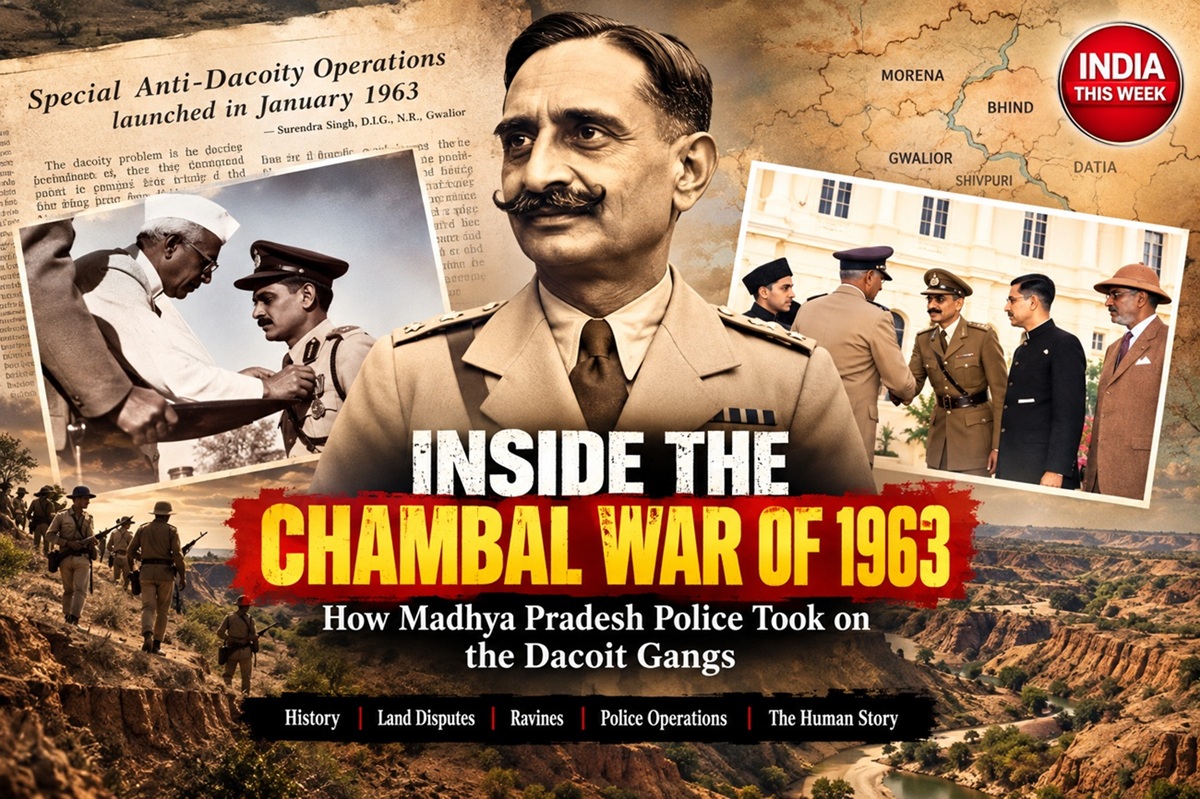
A remarkable six-page police account from January 1963 reveals how the authorities understood the Chambal dacoity problem—and why they believed guns and police operations alone could not solve it.
India This Week | Historical Archives : The Chambal ravines have long occupied a distinctive place in India’s history of crime, policing and rural conflict. In popular memory, the region became synonymous with dacoit gangs who disappeared into its maze of ravines, forests and villages, Inside the Chambal War of 1963
But a six-page police document from January 1963 provides a fascinating contemporary account of how the authorities themselves understood the problem.
Titled “Special Anti-Dacoity Operations launched in January 1963”, the document is attributed to Surendra Singh, D.I.G., N.R., Gwalior. It describes the background of dacoity in the Chambal region, the police preparations for a new offensive, the gangs being targeted, encounters during January 1963 and the administrative and socio-economic measures that the police believed were necessary to prevent new gangs from emerging.
It is, in effect, a snapshot of the Chambal problem as seen from inside the police administration more than six decades ago.
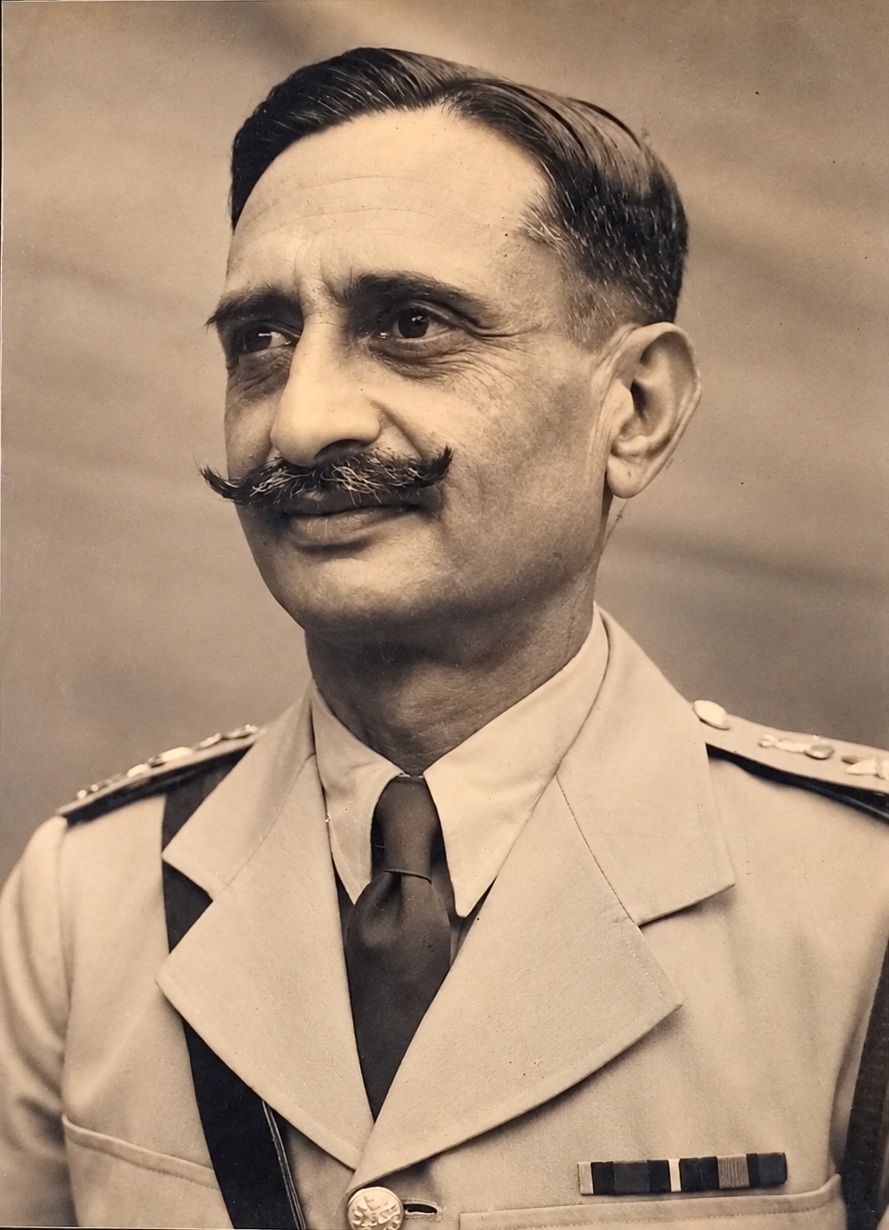
Former DIG Surendra Singh of Madhya Police
A problem the police believed had deep historical roots
The document does not begin with the police operations of 1963. Instead, it goes much further back.
It describes the Chambal valley and its tributaries as an area with a long history of providing refuge to people who were living in exile or attempting to escape authority.
The report refers to episodes associated with the Ramayana and the Pandavas, and then moves through the Mauryan period, the Delhi Sultanate, the Mughals and British rule.
It mentions Chandragupta Maurya, Sikander Lodi, Babar, Sher Shah Suri and Akbar, linking the region’s difficult terrain and history of rebellion to the continuing challenge of controlling it.
The document particularly recalls the British campaign against the Thugs and Pindaris, noting that Colonel Sleeman was given a special assignment and considerable forces and powers to suppress them.
According to the report, after the suppression of the Thugs, the region experienced a period of relative peace before local groups again became involved in criminal activity.
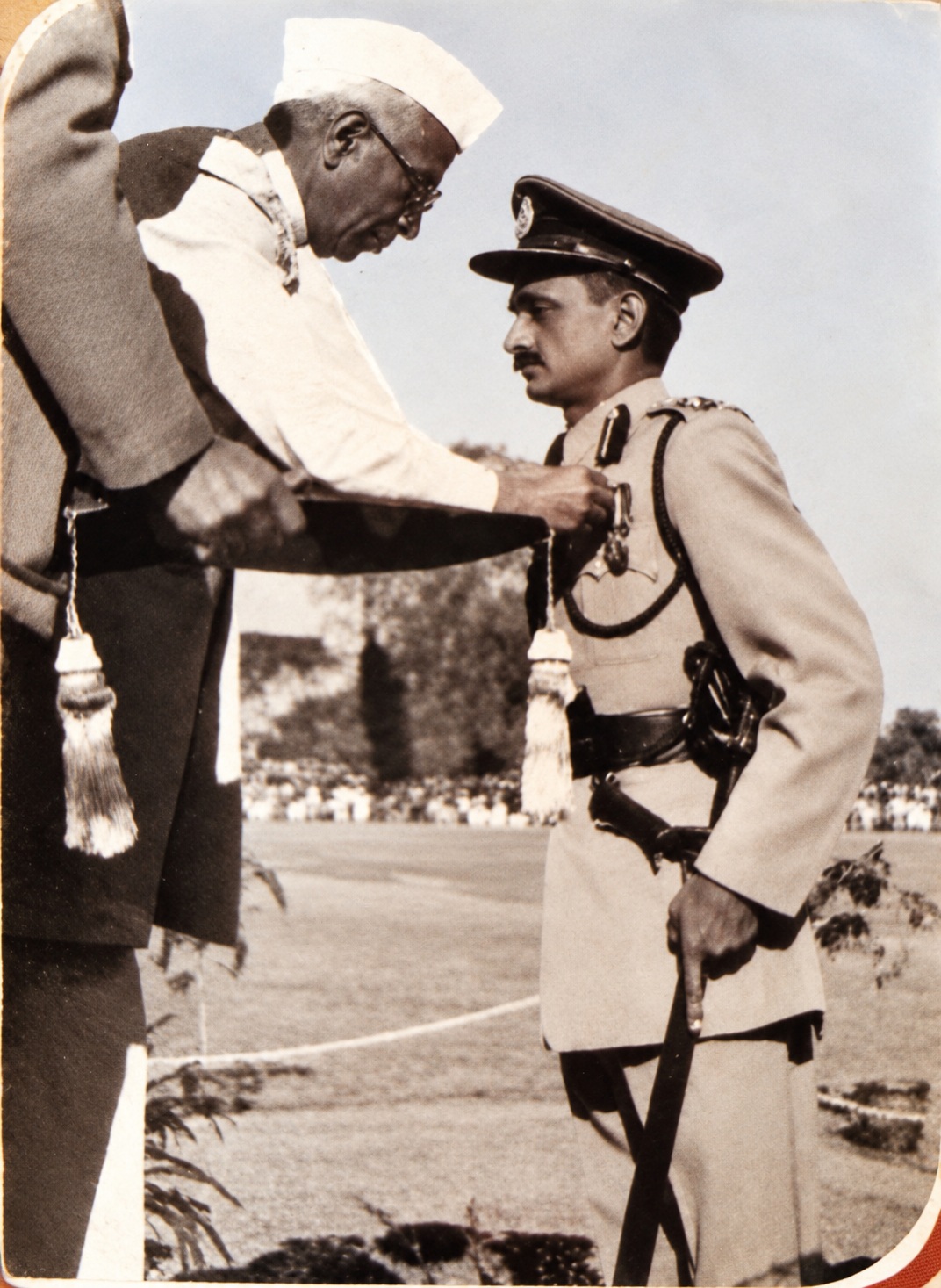
DIG Surendra Receiving police medal from His Excellency H. V. Pataskar, Former Governor of M. P
The making of the “Baghi”
One of the more striking observations in the report is its description of the social environment surrounding dacoity.
The document says that the long history of rebellion and lawlessness had affected the social culture of the ravine region. It uses the term “Baghi” for anti-social elements and says that becoming a Baghi did not necessarily carry social stigma in the area.
Indeed, the report claims that some such individuals were held in high esteem.
This, in the police’s assessment, made the problem considerably more complicated. The police were not simply confronting isolated criminals; they believed some gangs had a degree of social acceptance and local support.
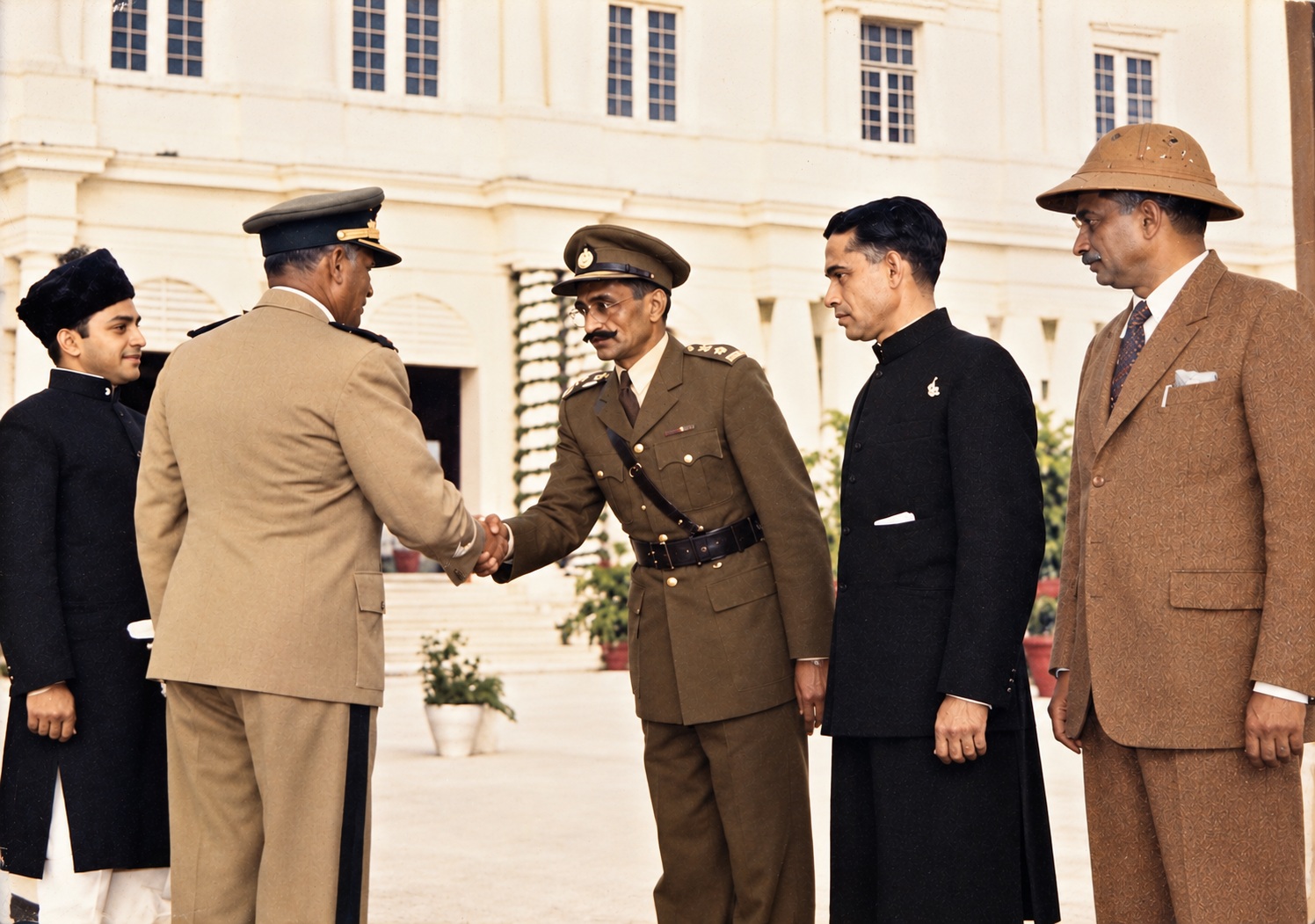
H. H. Jiwajirao Sindhiya, Marshall TiTo (President Czechoslovakia ) and Former DIG Surendra Singh.
Land disputes: the police’s explanation for the cycle of violence
The report then moves to what it considers one of the principal causes behind the emergence of dacoits: land disputes and village feuds.
According to the document, many dacoits were driven towards outlaw life by vengeance arising from disputes over land or conflicts between villages and families.
The report points to the shortage of cultivable land as one reason for frequent quarrels over possession.
It also makes a strong criticism of the justice system of the time. It says that legal proceedings had become complicated, slow and expensive, making it difficult for an ordinary villager to pursue a dispute through official channels.
The report specifically refers to delays in the Tahsildar’s Court in land matters and alleges that manipulation by local revenue officials could make matters worse.
The resulting sequence, according to the police analysis, was:
land dispute → frustration → violence → serious crime → escape into the ravines → formation or joining of a dacoit gang.
The document describes this as a “vicious circle” responsible for the emergence and continuation of outlaw groups in the region.
The ravines were an ally of the gangs
Geography was another critical factor.
The report repeatedly emphasises the importance of the ravines and thickly forested terrain.
For generations, this landscape had provided shelter from authorities. Dacoit gangs could disappear into areas that were difficult for conventional police forces to search.
The document also says that local people sometimes provided assistance and cooperation to the gangs.
Thus, according to the police assessment, three factors worked together:
difficult terrain + local support + firearms.
That combination made the Chambal particularly difficult to police.
Firearms and the legacy of the princely states
The report also discusses the availability of firearms.
It states that during the period of the former Indian States, there had been no Arms Act of the kind subsequently introduced, and that many families had members serving in the armed forces.
The report argues that weapons and ammunition also became more widely available during the upheaval surrounding Partition.
The result, according to the police account, was a population possessing a considerable number of firearms, which the authorities believed lowered the barrier to armed crime.
From princely rule to democratic administration
The document makes an interesting comparison between the old princely-state system and the post-Independence administrative structure.
It says that under the princely states, executive officers possessed extensive powers and cases could be disposed of relatively quickly, with punishment intended to act as a deterrent.
The arrival of democratic government and a separate judiciary changed that arrangement.
The report acknowledges that executive authorities could no longer exercise the same powers. As a result, the dacoity problem had to be approached through a combination of police action and socio-economic measures.
The report explicitly divides the anti-dacoity strategy into two broad categories:
- Police action
- Socio-economic uplift
That distinction is one of the most important themes running through the document.
The first major post-Independence offensive
The report says that the crime situation in the Bhind-Morena region attracted increasing public and press attention after Independence.
A Bhind-Morena Crime Situation Enquiry Committee was constituted, and its recommendations were submitted in 1958.
The report says that these recommendations resulted in further anti-dacoity operations.
It also records that full-scale anti-dacoity operations had been undertaken from 21 May 1957.
Several prominent gangs—including those associated with Amritlal, Roopa, Lakhan, Hazuri, Shankar Gujar, Barelal, Kalla-Putli, Gabbar, Shripala, Lal Singh and Pana—were described as having been eliminated during that period.
For a time, the authorities believed the dacoity problem had come under control.
But the situation subsequently deteriorated.
When the police presence weakened
The report identifies an important reason for the revival of the gangs: police resources were diverted to other parts of the State.
The document refers to communal disturbances, disturbances in Bastar and Bhilai, political agitation and difficulties in Nagaland.
As a result, police and State Armed Force units that had previously been available in the anti-dacoity area were sent elsewhere.
The report says that the force available in the area fell from approximately 32 companies to only 18–20 companies.
The police believed that the reduction in pressure created space for existing and new gangs to rebuild.
Some gangs consisted of remnants of previously broken groups, while others emerged from local disputes and land conflicts.
A new criminal model: kidnapping for ransom
The report makes another important observation about the changing nature of organised crime.
It says that some smaller gangs began avoiding conventional dacoity because it involved greater risk.
A traditional robbery could expose the criminals to identification and arrest, while disposing of stolen property could create further risks.
Kidnapping for ransom, in the police assessment, offered a more profitable alternative.
A victim could be abducted quietly and a ransom demanded without the gang necessarily having to conduct a large-scale robbery.
The report says kidnapping for ransom had therefore risen sharply during the preceding two years.
It proposed that the Government of India consider legislation providing deterrent punishment for kidnapping for ransom.
Politics and the gangs
The report also makes a striking reference to the General Elections.
It claims that caste and communal divisions became more prominent during elections and alleges that politicians sometimes attempted to obtain the support of criminal elements for political advantage.
This is an allegation contained in the 1963 police document and should be understood as the author’s assessment rather than treated as an independently verified conclusion.
Nevertheless, its inclusion shows that the police regarded the dacoity problem as extending beyond conventional criminality into the social and political environment of the region.
Why January 1963 became a turning point
By 1962, the deterioration in the situation had reached the attention of the Inspector-General of Police.
The report says the I.G.P. examined the situation and decided that “Special Operations” should be launched to put sustained pressure on the gangs.
The plan was initially delayed because of the Emergency arising in October 1962, following the India-China conflict.
By November, however, State Armed Force units elsewhere became available and forces began to be moved back towards the anti-dacoity areas.
The document also mentions the movement of the 4th Battalion, Bhind, to the border on 14 December 1962 and the need to replace the force that had been removed.
A high-level conference before the operation
The preparations culminated in a conference attended by senior officials.
On 17 December, according to the report, the Chief Minister and Deputy Minister (Home) held a conference of the Superintendents of Police and Collectors of the affected areas.
The conference was attended by senior officials including the Chief Secretary, Commissioner and Inspector-General of Police.
Detailed instructions were issued, and the report says that the political leadership continued to remain personally in touch with the operations.
Four districts at the centre of the campaign
The forests of Bhind, Gwalior, Datia and Shivpuri were identified as the areas most affected by dacoit activity.
The report identifies several important gangs:
- Mohar Singh Gujar
- Nathu Singh Thakur
- Bahadura Gujar
- Girdawalia Mirdha
- Sona Singh Thakur
- Balu Kirar, son of the late dacoit Amritlal Kirar
The police deployed State Armed Force units according to the movements of these gangs.
Pickets and ambushes were established, while protection guards were placed in villages affected by long-standing feuds to prevent further serious violence.
More officers and specialised sectors
The operation involved the temporary deployment of eight Deputy Superintendents/Assistant Superintendents of Police and 12 additional Sub-Inspectors from other ranges.
Gazetted officers were appointed as Sector Commanders in newly opened sectors.
Sub-Inspectors were attached to important police stations and assigned to accompany forces during raids and other operations.
The report says this arrangement relieved Station House Officers of some operational duties and allowed them to concentrate on:
- investigating serious offences;
- collecting intelligence on dacoit gangs;
- surveillance of criminals; and
- monitoring “bad characters.”
The operation begins
The Special Anti-Dacoity Operations officially began on 1 January 1963, under the guidance of the Inspector-General of Police.
The State Armed Force companies were used for:
- searching for dacoits;
- laying ambushes;
- conducting raids;
- combing forests;
- searching ravines; and
- maintaining pressure on gangs.
The report says the strategy kept the gangs constantly on the move and gave them less time to commit offences.
The police attributed a fall in crime during January to this strategy.
The January numbers
The document includes a comparative table covering December 1962 and January 1963 for Bhind, Morena, Gwalior, Shivpuri and Datia.
The total figures shown in the report were:
| Crime | December 1962 | January 1963 |
| Dacoities | 26 | 14 |
| Murders | 23 | 1 |
| Kidnapping for ransom | 19 | 13 |
The report presents these figures as evidence of an improvement after the special operations began.
The document also records 10 police encounters during January up to the period covered by the report, resulting, according to the police account, in the deaths of 17 dacoits.
A catalogue of encounters
The report then provides a detailed account of individual operations.
New Year’s Day: Harvilas Kirar
The first success described occurred on 1 January.
Shivpuri Police encountered local dacoit Harvilas Kirar in the jungle near Rajgarh, around 15 miles west of the Kolaras police station.
The report says Kirar was killed while the remaining members of the gang escaped in the darkness.
The Sobran Singh gang
In the Mou sector of Bhind, Sector Commander Mou concentrated efforts against the gang of Sobran Singh.
During a raid at village Makata, two members—Patiram Mirdha and Pannalal Chamar—were arrested.
The police report says a .12-bore DBBL gun, an SBML gun and ammunition were seized.
Five dacoits killed in an encounter
The report describes another encounter in the Mou sector involving the gang of Harvilas Mirdha.
Five members were reported killed, including:
- Rajaram
- Rampal Singh
- Mehtab Singh
- Ram Lakhan
- Gujari
The police recovered firearms from the site.
The Mohar Singh and Sarna gangs
The report says the gang of Mohar Singh, combined with the Sarna gang, had become particularly strong and had successfully evaded police for some time.
A police party eventually ambushed the gang near village Birona, P.S. Ron.
After an exchange of fire lasting approximately an hour, the police reported the death of Nehna Kachhi, described as an important member of Mohar Singh’s gang.
A .12-bore DBBL gun and ammunition were recovered.
The report says a reward of Rs 300 had been declared for Nehna Kachhi by the Inspector-General of Police, Madhya Pradesh.
The Bahadura Gujar gang
The report describes Bahadura Gujar’s gang as the oldest among the gangs then operating.
It says the gang had recently become stronger after merging with the local gang of Babu Bania.
An encounter near village Malpura, P.S. Bharoli, Bhind, resulted, according to the police report, in the deaths of six members:
- Babu Bania
- Matroo Chamar
- Rajaram Gadaria
- Fodal Kachhi
- Mantoo Singh Gujar
- Khyali Kachhi
The police reported recovering a .303 rifle, a Mauser, three .12-bore guns and ammunition.
The report also says that a kidnapped boy was rescued during the operation.
The police considered the encounter a major blow to Bahadura Gujar’s gang.
The Balu Kirar operation in Shivpuri
On 17 January, police encountered the gang of Balu Kirar in the jungle near village Sherguta, P.S. Kolaras.
Two members—Gulab Ahir and Thakur Lal Kirar—were reported killed.
The police recovered a .303 rifle with 20 rounds, three ML guns and other articles.
The report calls this the first encounter with Balu Kirar’s gang.
It also contains an interesting observation that supporters or receivers associated with the gang of Balu’s father, Amritlal, were allegedly spreading alarm in an effort to attract greater government attention to Shivpuri.
The Mohar Singh gang moves into Gwalior
Pressure from Bhind reportedly forced Mohar Singh’s gang towards the forests of Gwalior.
The police followed the gang there and encountered it near Pura Taletha, P.S. Antri, on 22 January.
The gang escaped into darkness, leaving behind several articles and a kidnapped man.
The report records that Sub-Inspector Malhotra, Station Officer of Antri, was wounded by a bullet during the encounter and was recovering in hospital.
Further encounters
The report also records an encounter near Rahuli, P.S. Lahar, Bhind, where dacoit Hardayal Dhobi was reported killed.
Another encounter took place near Rarura, P.S. Ron, involving the combined gang of Chhote Singh and Pan Singh.
Together, these incidents formed the operational record that the police used to demonstrate the effectiveness of the new campaign.
17 killed and 21 arrested
By the period covered by the report, the police claimed that 17 dacoits had been killed and 21 arrested.
The arrests were distributed across the region, with the report recording:
- 4 in Bhind
- 2 in Morena
- 9 in Shivpuri
- 6 in Datia
The report presents this as evidence that momentum had begun to build in the anti-dacoity campaign.
The death of Sub-Inspector Ganesh Singh
Behind the statistics, however, was a significant human cost for the police.
The document records the death of Sub-Inspector Ganesh Singh of P.S. Kosad.
According to the report, he was travelling alone on a bicycle to collect intelligence about dacoit gangs when he encountered members of the Girdawalia-Nathu Singh gang, who were retreating after an encounter.
He was shot and killed.
The report describes his death as an example of selfless service and says it raised the morale of the police force.
The force itself was struggling
Despite the successes, the report is remarkably candid about the difficulties facing the police.
One entire battalion had been removed from the area and replaced with new companies.
The new personnel had little familiarity with the local geography.
They had to learn:
- the terrain;
- geographical positions;
- local contacts;
- the physical demands of the ravine region; and
- the conditions under which anti-dacoity operations were conducted.
The report therefore expected that the new personnel would require time to become physically and mentally acclimatised to the area.
The transport problem
The police also faced a shortage of vehicles.
The newly deployed companies had reportedly arrived without their own transport, forcing the authorities to provide vehicles from existing resources.
This created a shortage in the anti-dacoity transport pool.
The report argues that improving motor transport would substantially increase the mobility of the force and allow police to respond more effectively to intelligence about gang movements.
It also mentions shortages of transport, radio equipment and Bren guns.
Part of the shortage, the document says, was linked to the deployment of four battalions in Nagaland and Assam.
Training for jungle warfare
The police response was not limited to deploying more men.
The Inspector-General had included jungle warfare and anti-dacoity work in the training syllabus for State Armed Force personnel.
Commandants were also posted for anti-dacoity work.
The system involved Sector Commanders and Zone Officers monitoring operational performance and holding periodic conferences to identify shortcomings.
The report says that the officers were not merely receiving classroom instruction. They were also gaining practical training in the field.
Each Zone Officer was provided with a company for training purposes.
The objective was to raise the operational standard of police personnel engaged in anti-dacoity work.
Village policing and 43,276 volunteers
The report also discusses the role of village-level security.
It says that after Chowkidars were transferred to the Revenue Department in April 1962, the performance of village police had declined.
The authorities subsequently attempted to address the problem with the help of district Collectors.
Some districts began paying Chowkidars through police stations, which the report believed would help restore police control over them and allow them to contribute more effectively to anti-dacoity work.
Even more significant was the role of Gram Raksha Samitis.
The report states that there were approximately 1,800 Gram Raksha Samitis, with a combined membership of 43,276 people, engaged in maintaining vigilance and guarding villages.
The long-term solution: development
Perhaps the most forward-looking section of the report comes at the end.
The police document explicitly says that the dacoity problem had a “socio-economic” dimension that had to be addressed alongside police action.
It recommends the development of cottage industries and other occupations so that pressure on cultivable land could be reduced.
The logic was straightforward: if landless people had alternative livelihoods, competition for scarce agricultural land could decline, potentially reducing land disputes.
More courts and faster justice
The report also recommends reducing the backlog of cases through the establishment of additional courts.
It argues that delays in civil and criminal cases were among the factors contributing to the formation of dacoit gangs.
The document’s reasoning was that if disputes were settled promptly, aggrieved people would have less incentive to take the law into their own hands.
It also calls for the Revenue Department to decide land disputes more quickly.
The China war and army deserters
The report contains another concern arising from the 1962 India-China conflict.
It says the Chambal area had historically been an important recruiting centre for the armed forces.
The authorities were therefore concerned about the presence of army deserters following the recent war with China and said this situation would have to be watched.
This illustrates how the police saw the security situation as connected to developments far beyond the ravines themselves.
Nine gangs versus nearly 30
The document ends on a cautiously optimistic but revealing note.
It says that the number of gangs in the area had fallen to approximately nine, compared with nearly 30 in 1956.
The police believed the remaining gangs could be eliminated if sufficient time and resources were available.
But the report immediately identifies the bigger challenge:
eliminating existing gangs was one thing; preventing new gangs from forming was another.
That distinction may be the most important conclusion of the entire six-page document.
The police believed that they could deliver heavy blows to the existing gangs through sustained operations. But unless the underlying conditions—land disputes, delays in justice, lack of livelihood opportunities and weak village-level administration—were addressed, new gangs could emerge.
What the 1963 document tells us about Chambal
The January 1963 police report is more than an operational record.
It is a window into the way the government viewed the Chambal dacoity problem at the beginning of the 1960s.
It shows a police force attempting to fight armed gangs through ambushes, intelligence, specialised sectors, increased manpower, forest searches and raids.
But at the same time, the report acknowledges that policing alone could not provide a permanent solution.
Its own analysis connected dacoity with:
land disputes, village rivalries, access to justice, poverty, unemployment, firearms, local support networks, difficult geography and weaknesses in village administration.
The report therefore envisioned a two-track response.
The first was immediate and coercive: find the gangs, pursue them, arrest or neutralise their members and disrupt their ability to operate.
The second was longer-term: improve administration, settle disputes quickly, expand livelihoods, strengthen village policing and prevent the social conditions that could produce another generation of gangs.
More than 60 years later, that combination makes the document an unusually valuable historical source.
It does not merely tell us how the police fought the dacoits in January 1963.
It also tells us how the authorities themselves believed that the dacoit problem had been created—and why they feared that defeating one generation of gangs would not necessarily prevent another from emerging.
Key facts from the January 1963 document
| Item | Details recorded in the document |
| Document | Special Anti-Dacoity Operations launched in January 1963 |
| Author | Surendra Singh, D.I.G., N.R., Gwalior |
| Operations began | 1 January 1963 |
| Main affected districts | Bhind, Gwalior, Datia and Shivpuri |
| Police encounters reported | 10 |
| Dacoits reportedly killed | 17 |
| Dacoits reportedly arrested | 21 |
| Gram Raksha Samitis | About 1,800 |
| Membership of Samitis | 43,276 |
| Dacoity cases | 26 in Dec. 1962 → 14 in Jan. 1963 |
| Murder cases | 23 in Dec. 1962 → 1 in Jan. 1963 |
| Kidnapping-for-ransom cases | 19 in Dec. 1962 → 13 in Jan. 1963 |
| Gangs mentioned at the end | About 9, compared with nearly 30 in 1956 |
These figures and descriptions are as recorded in the historical police document, not independently reconstructed statistics.
Source: Special Anti-Dacoity Operations launched in January 1963, six-page historical police document attributed to Surendra Singh, D.I.G., N.R., Gwalior. The article is based on the supplied scan and preserves the document’s historical perspective and terminology. Dr. Yogendra Parihar an Renowned doctor for Bilaspur, Chhattisgarh son of former DIG Mr. Surendra Singh)