
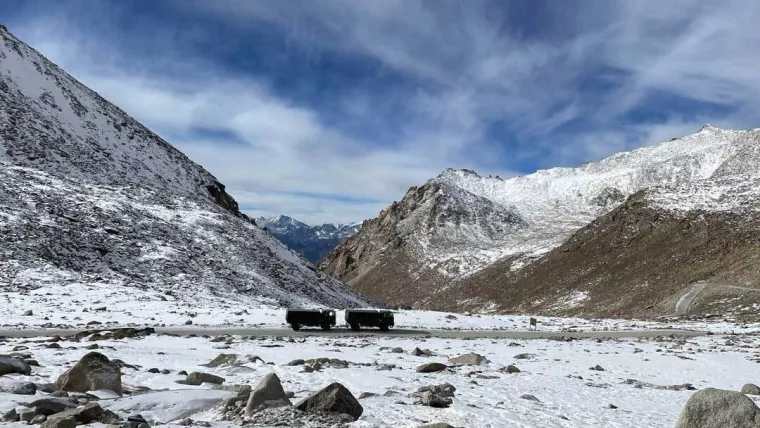
Following the 2020 standoff with China, India is constructing roads, tunnels, and airstrips in the Himalayas to improve military logistics along the LAC.
Since the disastrous 2020 conflict revealed significant logistical deficiencies, India is constructing roads, tunnels, and airstrips as part of a massive infrastructure push across the Himalayas to improve its military posture along the Line of Actual Control (LAC) with China, according to the Wall Street Journal.
Since the disastrous 2020 conflict revealed significant logistical deficiencies, India is constructing roads, tunnels, and airstrips as part of a massive infrastructure push across the Himalayas to improve its military posture along the Line of Actual Control (LAC) with China, according to the Wall Street Journal.
The 2020 standoff, which killed soldiers on both sides, showed logistical obstacles for India while moving reinforcements and supplies across its own mountainous frontier.
India would have needed up to a week because of the difficult terrain and poor connection, analysts told WSJ, while China could have sent troops to the region in hours because to its vast network of border roads and railroads.
Major General Amrit Pal Singh, the former head of operational logistics in Ladakh, was quoted by WSJ as saying, “It was a dramatic shift in thinking … we realized we needed to change our total approach.”
Also read : PM Modi to Chair Fifth National Conference of Chief Secretaries on Human Capital Development
The 11,500-foot-long Zojila tunnel in northern India is one of the most ambitious undertakings.
Months after the 2020 conflict, construction on the more than $750 million tunnel started.
According to the report, once the tunnel is finished, it should shorten travel times and guarantee year-round access to Ladakh, which is frequently cut off for up to six months owing to severe snowfall.
Supplying high-altitude posts is still a difficult undertaking, though.
Essentials are transported by trucks and trains to depots in Jammu and Kashmir, from where convoys travel to Leh. After that, smaller vehicles travel across uneven ground, and porters and mules frequently carry the last portion, which is at elevations close to 20,000 feet.
According to former Northern Command chief Lt. Gen. Deependra Singh Hooda, “it’s a massive, massive logistical exercise undertaken regularly every year,” he told WSJ.
He stated that each soldier needs about 220 pounds of supplies every month, while a tiny outpost can consume roughly 13 gallons of gasoline a day. “Someone needs to bring that up on their shoulder at that post.”
India has increased air connections as well. The WSJ claims that New Delhi has constructed or renovated a number of airstrips near the border and constructed more than 30 helipads. The Mudh-Nyoma airport in Ladakh, which is only 19 miles from the Chinese border and at an elevation of almost 14,000 feet, is a crucial addition. It can handle bigger cargo planes like the C-130J.
Daniel Markey, senior scholar at the Stimson Center, told WSJ that India has almost “rolled out the red carpet” to a Chinese invasion since the earler perspective was that developing big roadways was really militarily damaging to the country.
Also read: Pradhan Mantri Rashtriya Bal Puraskar 2025: President Murmu Congratulates Brave and Talented Children
But as China quickly constructed rail and road networks to fortify Tibet and Xinjiang in the mid-2000s, attitudes started to change.
There are risks associated with the push. Increased patrol activity and infrastructure might make conflict more likely, analysts warned WSJ, particularly in contested areas like Pangong Tso where both forces are present despite a disengagement agreement.
However, Indian officials do not view the build-up as a race with China, but rather as a deterrent. Singh was quoted by the WSJ as adding, “We’re not going overboard.”