
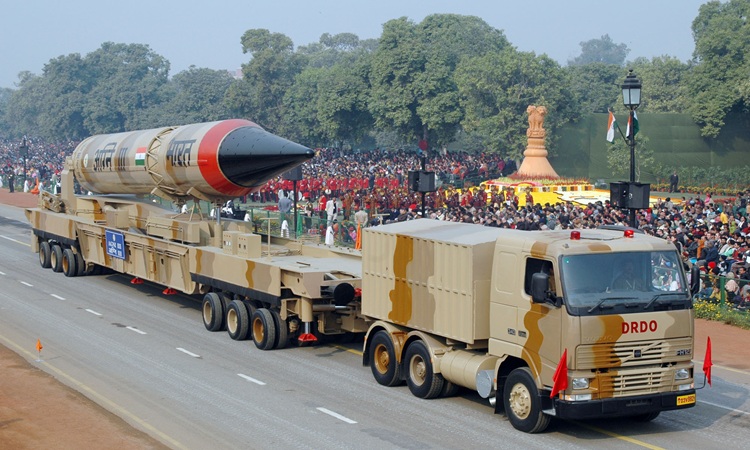
India continues to expand and modernize its strategic force posture while maintaining its long-standing No First Use policy. A comprehensive study published by the Bulletin of the Atomic Scientists estimates that India possesses roughly 190 nuclear warheads. However, a nuclear arsenal relies entirely on its delivery platforms to project effective deterrence deep into hostile territory.
India Nuclear Arsenal Expands With Long-Range Missiles Across Multi-Domain Forces
The report authored by researchers Hans M. Kristensen, Matt Korda, Eliana Johns, and Mackenzie Knight-Boyle confirms that India operates an operational nuclear triad. This capability combines air-delivered systems, land-based ballistic missiles, and sea-based nuclear deterrence platforms.
The assessment notes that India maintains strict official opacity regarding exact missile specifications. Consequently, operational ranges and warhead counts published by overseas analysts rely on open-source verification and technical estimates.
| Delivery Vector Category | Primary Platforms In Service | Operational Strategic Role |
| Air-Based Strike | Mirage 2000, Jaguar, Rafale | Deep penetration tactical & strategic strike |
| Land-Based Missiles | Agni Series (Agni I through Agni V) | Long-range deterrence & MIRV capability |
| Sea-Based Deterrent | INS Arihant, INS Arighaat, INS Aridhaman | Assured second-strike survivability |
Airborne Vectors and Multi-Role Fighter Jets Maintain Strike Capabilities
India fields two legacy fighter platforms with dedicated nuclear delivery roles. The French-acquired Mirage 2000 remains a principal strike platform alongside the joint Anglo-French Jaguar. Additionally, modern Rafale jets acquired from France are positioned to assume primary air-strike duties as older aircraft face phased retirement.
| Airborne Platform | Country of Origin | Operational Mission Status |
| Mirage 2000 | France | Principal air-based nuclear strike platform |
| Jaguar | United Kingdom / France | Secondary nuclear delivery role |
| Rafale | France | Modern multi-role replacement platform |
Indigenous Agni Series Forms Backbone of Land Deterrence
The Defence Research and Development Organisation developed the Agni missile series to form the primary land-based leg of India’s strategic deterrent. The operational inventory includes six distinct ballistic missile systems: Prithvi II, Agni I, Agni II, Agni III, Agni IV, and Agni V. The newer Agni Prime missile is also approaching full operational deployment.
The canisterized design of Agni V allows rapid launch response while facilitating deployment deeper within Indian territory. Furthermore, Agni V has demonstrated Multiple Independently Targetable Re-entry Vehicle technology, allowing a single missile to engage multiple separate targets.
| Missile System | Estimated Strike Range | Key Technological Feature |
| Agni I | ~700 km | Short-range road-mobile system |
| Agni II | >2,000 km | Medium-range solid-fueled system |
| Agni III | >3,200 km | Intermediate-range rail-mobile missile |
| Agni IV | >3,500 km | Composite rocket motor technology |
| Agni V | <6,000 km | Canisterized launch with MIRV capability |
Sea-Based Leg Achieves Maturity With Third Ballistic Submarine
India completed a major milestone in sea-based deterrence with the commissioning of INS Aridhaman. The SSBN joins INS Arihant and INS Arighaat in maintaining continuous sea patrols.
Carnegie Endowment for International Peace
Submarine-launched ballistic missiles like the K-4 offer continuous underwater stealth. This capability ensures that India retains a guaranteed retaliatory capability even after absorbing a first strike.
Carnegie Endowment for International Peace
The reality that India nuclear arsenal expands with long-range missiles underscores a sophisticated deterrence posture focused entirely on maintaining strategic stability across the region.