
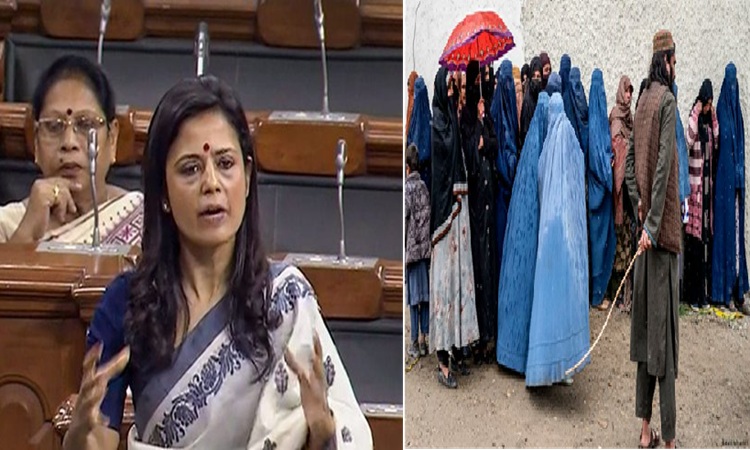
Trinamool Congress MP Mahua Moitra has launched a fierce critique of the Taliban’s newly introduced Anti-Women penal code in Afghanistan. The controversial legal framework reportedly legitimizes domestic violence and reduces the status of women to that of “slaves.” Moitra expressed her outrage on social media, stating she “hangs her head in shame” as an Indian woman. Her comments follow alarming reports from human rights groups about the “Penal Principles of Taliban Courts,” a 119-article document enacted in early 2026. This new code formalizes gender-based brutality and strips women of their fundamental legal personhood.
The Indian government laid out the red carpet for this very Taliban a few months ago. As an Indian woman I hang my head in shame. For my Afghan sisters – we stand with you against these demons. pic.twitter.com/4MEuHngY3f
— Mahua Moitra (@MahuaMoitra) February 22, 2026
A Legal Framework for Gender Apartheid
The reported details of the new penal code have sent shockwaves through the international community. According to rights groups like Rawadari, the code explicitly divides Afghan society into hierarchical classes. Most disturbingly, it uses terminology that places women on the same legal footing as “slaves” or “dependents.” Under Article 32 of this new regulation, husbands are granted discretionary power to physically punish their wives.
The law reportedly permits domestic violence as long as it does not result in “broken bones or open wounds.” If a woman manages to prove “excessive beating” in court—a nearly impossible task under current restrictions—the perpetrator faces a maximum of only 15 days in prison. Moreover, the code criminalizes basic autonomy, such as leaving the home without a male guardian’s permission. Activists warn that these provisions do not just allow abuse; they transform it into a state-sanctioned religious and legal obligation.
Moitra Targets India’s “Red Carpet” Diplomacy
Mahua Moitra did not limit her criticism to the Taliban. She also took a sharp swipe at the Indian government’s recent efforts to engage diplomatically with the Kabul regime. In late 2025, India upgraded its technical mission in Kabul to a full embassy. This move followed high-profile visits from Taliban officials, including Foreign Minister Amir Khan Muttaqi. Moitra accused the Centre of “laying out the red carpet” for a group that codifies brutality against women.
This is not the first time the TMC leader has questioned the government’s foreign policy regarding Afghanistan. In October 2025, she condemned a press conference held by Taliban officials in Delhi where women journalists were reportedly excluded. She described the engagement as a “dishonor” to every Indian woman. While New Delhi maintains that its engagement is based on “pragmatism and security,” critics like Moitra argue that diplomatic proximity emboldens a regime that practices “gender apartheid.”
The Global Cost of Inaction
The enactment of this penal code marks a grim milestone in the Taliban’s five-year rule. Since 2021, the group has issued dozens of decrees stripping girls of education and barring women from most jobs. However, the 2026 penal code represents the most formal institutionalization of these restrictions. It replaces the 2009 Elimination of Violence Against Women (EVAW) law with a system where survival for women is increasingly criminalized.
Also Read : ‘Kitne Ghazi Aaye, Kitne Ghazi Gaye’: Army Neutralizes JeM Terrorists in Operation Trashi-1
International rights organizations are now calling for an immediate halt to the implementation of these regulations. They warn that the code creates a psychological and social landscape where violence is the law. As the debate in India intensifies, the central question remains: how can democratic nations balance regional security interests with the moral obligation to protect the rights of the Afghan people?