
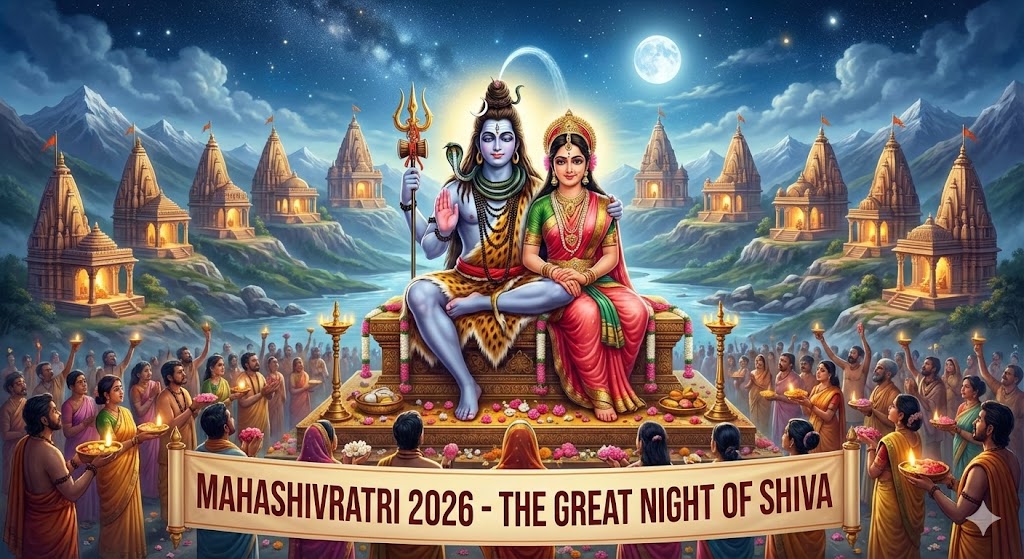
New Delhi, India: Spiritual fervor swept across the Indian subcontinent on February 15, 2026, as millions celebrated Mahashivratri 2026. From the snow-capped peaks of the Himalayas to the coastal shrines of the south, the “Great Night of Shiva” witnessed an extraordinary display of faith. Devotees gathered in record numbers to observe traditional rituals, marking the divine union of Lord Shiva and Goddess Parvati.
Prime Minister Narendra Modi extended his greetings to the nation, praying for global well-being and prosperity. He specifically highlighted the “Herath” celebrations of the Kashmiri Pandit community. Across the country, the atmosphere resonated with the chants of “Om Namah Shivaya” and “Har Har Mahadev.”
Record Crowds at Jyotirlingas and Holy Ghats
The 12 Jyotirlingas remained the epicenter of the festivities. In Ujjain, the Mahakaleshwar Temple opened its doors for a continuous 44-hour darshan. The day began with the iconic Bhasma Aarti at 3:00 AM, where the deity was adorned with sacred ash. Authorities estimated that nearly 10 lakh pilgrims visited the shrine by Saturday evening.
Similarly, Varanasi saw an overwhelming influx of devotees at the Kashi Vishwanath Temple. Thousands took a holy dip in the Ganges before offering Ganga Jal and Belpatra to the Shivalingam. In Prayagraj, the Mahashivratri snan marked the final auspicious dip of the Magh Mela 2026. Approximately 10 lakh people reached the Sangam ghats despite chilly morning temperatures.
Spiritual Awakening at Global Yoga Centers
Modern spiritual hubs also saw massive participation. The Isha Yoga Center in Coimbatore hosted its world-renowned night-long event led by Sadhguru. Defence Minister Rajnath Singh and other dignitaries joined over 140 million digital viewers for the “Pancha Bhuta Kriya” and explosive meditations. The 112-foot Adiyogi statue served as a majestic backdrop for cultural performances.
In Karnataka, the Kotilingeshwara Temple and the Virupaksha Temple in Hampi drew thousands of seekers. Many devotees observed a strict Nirjala fast, staying awake through the four prahars of the night. This year’s astrological alignment under an Aquarius stellium added a layer of significance for many practitioners.
Tradition Meets Development in 2026
While ancient rituals remained unchanged, the 2026 celebrations showcased improved infrastructure. The “Vibrant Villages” initiative allowed frontier communities in the North to celebrate with better accessibility. In Odisha, the submerged Lingam at Lokanatha Temple was revealed to the public, attracting thousands to the holy town of Puri.
As the Nishita Kaal (midnight) puja concluded, the focus shifted to the morning of February 16 for the Parana (fast-breaking) ritual. For many, Mahashivratri 2026 was not just a festival, but a powerful reset for personal growth and national unity.
Also Read : Maha Shivratri 2026: Common Jalabhishek Mistakes Devotees Should Avoid to Receive Lord Shiva’s Blessings